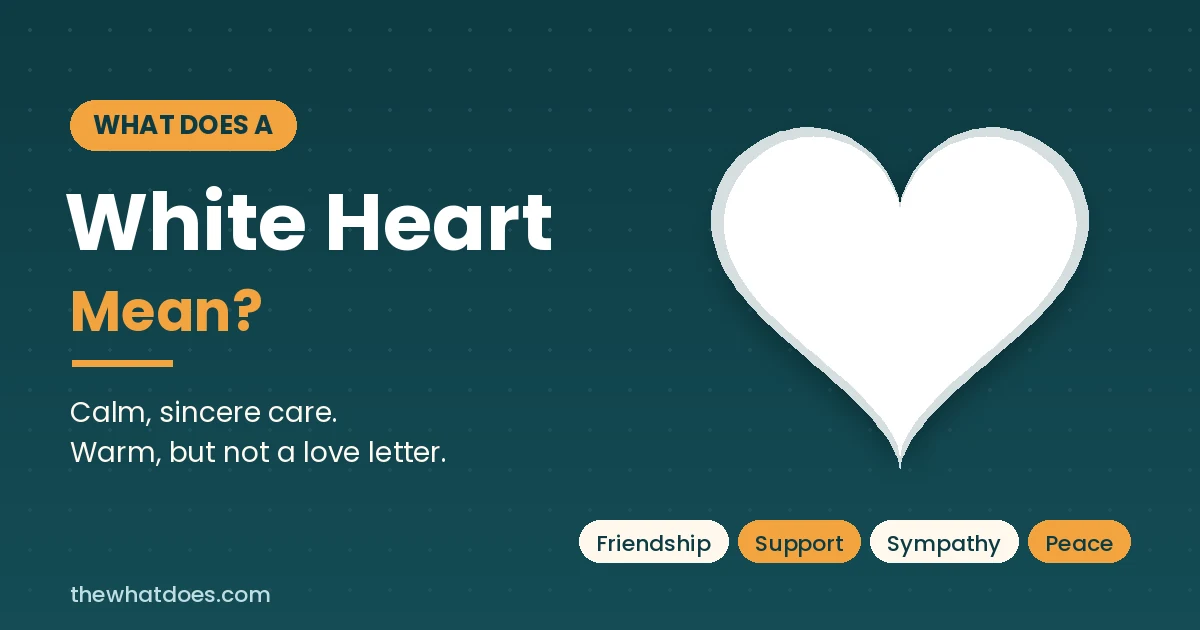
The white heart 🤍 generally symbolizes a peaceful and sincere expression of affection that isn’t romantic in nature. This is the emoji people use when wishing their friend who had a bad week, their family member on their birthday, or anyone else that they really like, but aren’t flirting with. The white heart also appears very often when posting condolences or in memory of someone.
This is an affectionate emoji, only a silent one. So while the red heart says “I love you”, the white heart says more of “I’m here” or “I care about you”.
The Short Version:
| Question | Answer |
|---|---|
| Main meaning | A gentle, sincere affection, often platonic in nature |
| Also used for | Empathy, memory, serenity, a refined design |
| Romantic? | Occasionally, yet not as strong as a red heart |
| When it arrived | Added to the emoji keyboard in 2019 |
| Safe to send | To everyone, even to coworkers and relatives |
| Closest cousin | The pink heart, which is more affectionate and playful |
The Six Things a White Heart Can Mean:
Now, what do these mean if the actual message contains a white heart emoji? There are six major uses that encompass pretty much everything.
Platonic love. Far and away, the most used type. Friends, relatives, siblings, cousins, a role model. It means the love is real but doesn’t involve anything else.
Support. “I believe in you 🤍” before an exam or an interview. It works perfectly for encouragement since white conveys steadiness.
Sympathy and commemoration. Used often in sympathy notes and posts about deceased people, it is one of the most frequently used emojis since it carries warmth but not cheerfulness.
Peace and calmness. Captions on Sundays or about a relaxing walk. In this case, it’s more of an attitude than an emoji.
Clean design. On Instagram, there are many instances where users just like its looks in conjunction with neutral and minimalist photographs.
Soft romance. Between lovers it stands for love that has found its peace and isn’t about excitement anymore. It’s love that grew up.
What a White Heart Means From a Guy or a Girl:
It is the one that everyone actually means when asking about it, especially since they got one from the person who means a lot to them.
In itself, a white heart is a sweet but a non-committal one. It feels quite comfortable in the friend zone and can work at an earlier stage of something romantic, hence the ambiguity.
Here are a few factors that can give a hint:
- The general pattern of what they normally send. If they normally send hearts of any color, using only white with you is a step backward. If they don’t ever use hearts, a white one is a step forward.
- What they are sending it with. “Thank you for today 🤍” after a date counts more than a reaction to a meme.
- Timing. An evening message with a 🤍 on it is not the same as a morning one between appointments.
- Whether it’s a one-time gesture or a new pattern of theirs.
If you really need to know where you stand, emojis won’t help. The dialogue will.
How to Reply to a White Heart:
| What it came with | A reply that fits | Why |
|---|---|---|
| A thank-you from a friend | “Always 🤍” | Matches the tone without making it bigger |
| Encouragement before something | “Thank you, I needed that” | Acknowledges the support directly |
| A condolence message | “Thank you, it means a lot” | No emoji needed, and none is expected |
| From someone you like | Something real, plus a question | Keeps the conversation going |
| On your post | A like, or nothing | Reactions don’t need replies |
When you receive a white heart while grieving, there is no need for you to reply with anything else. The heart was given to save you the effort of finding words.
Using It for Condolences:
And that’s how the white heart became a true match. Sympathy messages are not easy to compose and it may sound strange that a red heart looks somehow too flashy next to information about the death.
White is less emotional. The heart symbolizes warmth and presence instead of any kind of emotion that one might need after losing a loved one. Moreover, white has a long history of association with peace and memory in other cultures.
In case you send sympathy cards to people with another cultural background it is worth to know that in India, China and most parts of Asia white is the traditional color of mourning, and therefore the white heart comes in handy for these cards. It’s enough to use a few lines with the white heart at the end of the message.
White Heart vs Other Heart Colors:
While there are no official heart colors, they have come to signify certain things.

| Heart | Usually means | Compared with white |
|---|---|---|
| ❤️ Red | Romantic love, strong feeling | Much more intense |
| 🤍 White | Calm, sincere care | The baseline here |
| 🩷 Pink | Sweet, playful affection | Softer on romance, more cute |
| 🖤 Black | Dark humor, grief, edgy style | Heavier, sometimes ironic |
| 🧡 Orange | Friendly warmth, just short of romance | Brighter, more casual |
| 💛 Yellow | Friendship and happiness | Cheerful rather than calm |
| 💙 Blue | Trust and loyalty | Similar weight, cooler tone |
| 💚 Green | Nature, health, sometimes envy | More topical than emotional |
| 💜 Purple | Affection, often in fan communities | Warmer, more expressive |
| 🤎 Brown | Grounded warmth, sometimes identity | Added the same year as white |
The general principle is that white is the most reliable heart for an uncertain occasion. It hardly ever misses its target.
Why It Sometimes Looks Invisible:
One technical detail that is good to know about. Against a white background, particularly light mode, the white heart can become an almost invisible outline.
It is normally outlined in a very fine grey line to avoid this problem, but it will still be significantly less noticeable than any other heart. If people say they did not see your heart, it’s because of this.
Against a dark background, it becomes extremely noticeable.
Where the White Heart Came From:
The emoji is not as old as one might think; it was introduced into the set of emojis in 2019, alongside the brown heart, as part of a trend aimed at giving people a wider range of colors to choose from.
Prior to that, the symbol of choice for someone seeking a gentler heart was the outline symbol ♡, which has been available on keypads for years now. The strange thing about this is that its Unicode name is White Heart Suit, due to playing cards, where “white” means outline and not color.
In other words, there have actually been white hearts around for ages, but they were not called that.
Common Mistakes People Make With the White Heart:
- Interpreting it as rejection. A white heart from your crush doesn’t mean no. It’s typically just kind and considerate.
- Interpreting it as a confession. The other extreme. It’s loving but not an announcement.
- Sending a red heart to a mourning person. It might be too vibrant. Send a white heart or no emoji.

- Thinking it’s impersonal because it’s colorless. White means neutral and soothing.
- Responding to someone’s condolences with a heart. Nothing wrong with that if you want to, nothing wrong with ignoring their message too.
- Failing to switch the light mode on. On the white background it would hardly be noticeable. Add words if it’s important.
White Heart Trivia:
- The white heart emoji was introduced in 2019, along with the brown heart.
- The older outline heart ♡ is called White Heart Suit in official Unicode terms, based on playing cards.
- The old Unicode naming system has white indicating an outline shape and not a color.
- White is the color of mourning in much of Asia, which makes it fitting for the use in condolences.
- Pinks, light blues, and greys were introduced a few years later.
- Light backgrounds have a border drawn around the heart so that it does not vanish.
Final Take:
The answer as to what a white heart means in its most basic form is constant and sincere affection. This affection is warm without being in any way romantic, is supportive without being too emotional, and is kind enough to send when a loved one has passed away.
This is exactly why it is so difficult to tell whether someone is trying to communicate something romantic and exactly why it is easy to send this symbol to everyone else.
Frequently Asked Questions:
It is usually warmth and genuine love, mostly platonic. It may be romantic in the beginning, but it is a little less intense than a red heart, so it should be taken along with all other things said during the conversation.
Exactly the same as from anyone else – genuine and peaceful affection. If it is romantic or not will depend on what kind of other emojis he usually uses and what does he use the heart for.
It may be sometimes, but usually platonic. If it is sent between couples, it shows that their relationship has become a calm and comfortable one.
Yes, frequently. This emoji is one of the most popular ones in condolence posts.=
The red one is passionate and always romantic, while the white one is tranquil and platonic. The former conveys passion, and the latter expresses consistency.
Mostly as decoration, since it fits perfectly well into neutral photos and pictures of soft feelings and support. For memorial stories, it serves as a sign of respect.
In 2019, along with the brown heart. Before the release of emojis, users used the heart outline symbol ♡.
Just follow the trend of the sender. Either a white heart or a simple thank you, or even an actual response. If it came with condolences, there’s no need to answer at all.
Also, Read: What Does FAFO Mean | What Does Big Back Mean | What Does Pushing P Mean | What Does TBH Mean | What Does OG Mean? | What Does YN Mean | What Does WTW Mean | What Does SYBAU Mean | What Does NASA Mean in Hebrew | What Does Bomboclaat Mean