


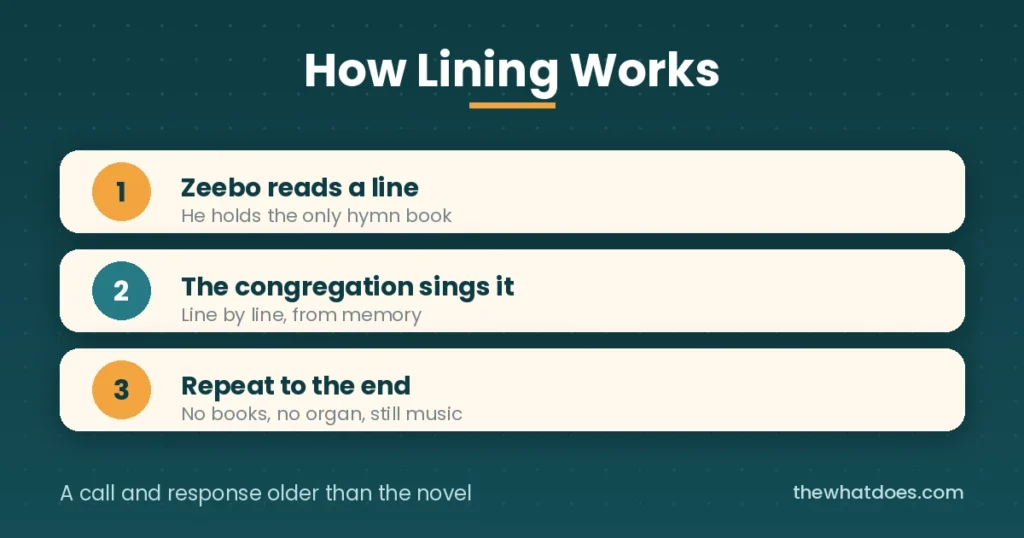
Zeebo is the music superintendent of First Purchase African M.E. Church, and this means that he directs all the singing. Since there are no hymnals for the congregation and few people can read, he chants every line of the hymns, and they repeat after him. This ritual is known as lining.
This scene is depicted in Chapter 12 when Calpurnia takes Jem and Scout to her church in the absence of Atticus. Zeebo is her oldest child, while normally he serves as a garbage man in Maycomb.
The Short Version:
| Question | Answer |
|---|---|
| What he does at church | Leads the hymns as music superintendent |
| How he does it | By lining: he reads a line, the congregation sings it |
| Why that’s necessary | No hymn books, and most of the congregation cannot read |
| Which chapter | Chapter 12 |
| Who he is | Calpurnia’s eldest son |
| His job in town | Garbage collector |
| Why he can read | Calpurnia taught him |
What Lining Actually Is:
Answering what does Zeebo do at the church properly means explaining lining, because that’s the detail the question is usually testing.
Lining, or lining out, is a call and response style of singing which is a very old practice and one which used to be widely practiced in congregations when books were not available, or people did not know how to read.
The reason for it being used in the church of First Purchase is simply because of their utter poverty and ignorance. There is no money available for hymn books, and even if there was any, they would not be able to read them anyway. Only Zeebo owns a book in the whole church.
Scout, having seen only a church where everything was written down in books, is bewildered as to how they will be able to sing without books. And then it begins, and she is quite astonished by it.
Who Zeebo Is:
Zeebo is a minor character who holds quite an important place due to the number of lines allotted to him.
- Calpurnia’s oldest son. That is what makes the scene relevant.
- Maycomb’s sanitation man. The kids get to know him in this role, which is precisely the purpose of this little detail.
- One of those rare literate people in the community. Together with Calpurnia and Reverend Sykes.
- Was taught how to read by his mother. Through the Bible and the legal book, which once belonged to the Finch family.
- It is he who puts everything right when Lula disapproves of the white children in the church and warmly greets them and advises not to pay attention to anything.
Why the Scene Matters:
The teachers wonder about Zeebo because this scene serves several purposes.
It challenges the children’s assumptions. Jem and Scout know Zeebo as the man who drives the garbage truck. In church, he stands at the front with the only book, conducting everybody else. Scout sees Jem looking at him sideways, trying to figure out how both men can be the same person.
It reveals what kind of woman Calpurnia is. She taught her son to read when it was unusual, using the few books she had. The reader has met her for eleven chapters as the Finch family’s cook. Now, he sees another side of this woman, a mother, a teacher, and a person with a complete life that the children have never known.
It reveals the poverty without mentioning it. There is no paint, no hymnals, no music, and a congregation denied of the opportunity to learn reading. Harper Lee does it through descriptions.
This church contrasts with the white one. Scout’s own congregation has all the things that are lacking at the First Purchase. Moreover, there will be an episode with missionary ladies that shows a hypocrisy which does not exist at this church service.
How Zeebo Learned to Read:
And it’s this small piece of information that makes her more than a background figure in the story.
Calpurnia had learned to read when she was young, tutored by one of the members of the Finch family, and the only books she had access to then were a Bible and an ancient tome of English law which had belonged to the father of Atticus. Having borne a child, she raised him using those same two books.
Reading a legal treatise to learn how to read is a joke, and this is exactly the idea the author wants to convey. There was no school for him; there were just those books which Calpurnia had and her resolve, and from this came a man who could stand before the congregation and conduct a hundred people in hymn singing.
Jem and Scout knew Calpurnia all their lives and nothing about that.
What Else Zeebo Does in the Novel:
He comes back twice in a way that makes the two portrayals deliberate.
In chapter 10, after Atticus puts down the mad dog Tim Johnson, Zeebo shows up with the rubbish collection truck and carts away the corpse. He’s performing a task no one else wants to do behind someone else’s glory.
The same character comes back in chapter 12 standing before his congregation directing a hundred unaided voices.
Seeing those two images together is the entire point of the scene, which is most likely what the essay question is looking for.
A Word About First Purchase:
The name of this church will be significant to know if you are writing this chapter.
It is called “First Purchase” as it was purchased by the free Negroes by their first earnings. It is an old and unpainted church that is used by the worshippers on Sundays and white gamblers on weekdays.
Reverend Sykes presides over the ceremony, takes a collection for Helen Robinson and locks the doors until the necessary amount is donated. Zeebo’s job is singing.
What Scout Notices About Calpurnia:
The other aspect that the children learn on this particular Sunday always comes into play in a similar list of questions, so it should be taken into account, along with the Zeebo one.
In the Finch house, Calpurnia uses one language. In First Purchase, she uses another one, just like the people that surround her. Scout pays attention to this fact and makes a question. Calpurnia tries to explain that there is no sense in addressing people in such a manner that would show the fact that one considers himself better than others.

This small conversation regarding language reveals a deeper meaning that concerns belonging to two different worlds simultaneously.
How to Answer This in an Essay:
In case this has appeared as homework, a good response should contain three parts and be about four sentences long.
- Identify the function. Zeebo is the music superintendent at First Purchase and directs the congregation in singing hymns.
- Describe the technique. He directs the hymns by first saying out loud each line of the hymn so that the congregation can sing it back because there are no hymn books in the church and most members cannot read.
- Explain the significance of this. Zeebo is literate, which is unusual, and he is so due to the efforts of Calpurnia, who taught him; she is now revealed in a new light to the children.
- Include the contrast if possible. The children had only known him to be gathering trash, and now seeing him direct the church is surprising to them.
Write your own response; do not plagiarize from summaries online; your teacher knows them and your version will say more anyway.
Common Mistakes People Make:
- Attribution of the singing to Reverend Sykes. He conducts the service. Zeebo conducts the singing. This mistake appears in some summaries of the book.
- Claiming that there is no music in the church. It has no musical instruments. The church actually has plenty of music.
- Considering Zeebo as the preacher. He is the music superintendent and not the preacher.
- Not taking into account the garbage truck. The juxtaposition of the two occupations makes his inclusion in the story relevant.
- Stating that none of them can read. Calpurnia, Reverend Sykes, and Zeebo can read.
- Confusing chapters. The dog chapter is Chapter 10, while the church chapter is Chapter 12.
Trivia Worth Knowing:
- Lining out is an actual phenomenon that has existed for many years in both British and American churches, and it did not just spring up in the novel.
- Calpurnia learned to read on her own and in turn taught Zeebo using a Bible and an English law book.
- Zeebo possesses the only hymnbook in the whole building.
- The church got its name due to the very first money earned by freed slaves.
- Scout realizes that Calpurnia has different ways of talking at the church compared to how she talks at the Finches’.
- The chapter marks the start of Part Two of the novel.
The Other Zeebo:
In case you have been looking for this name expecting some other information, there was a video gaming console that was known as Zeebo.
This console had appeared in Brazil somewhere in 2009. It was intended to be used in those markets where the cost of cartridges and CDs was high. The games could be downloaded through the mobile network. It was discontinued after two years of its appearance.
Absolutely unrelated to the book. Just two objects having an uncommon name in common.
Final Take:
The answer to what does Zeebo do at the church is that he leads the hymns as music superintendent, lining them out so a congregation without books or reading can sing together.
It’s a tiny part played in a small scene, and it is through this that Lee creates the garbage collector into the man standing at the front, while the housekeeper becomes the one who taught him how to read. This is the reason why the question has remained persistent.
Frequently Asked Questions:
He is the music superintendent. His job entails leading the congregation in singing of hymns through lining of hymns where he says each line and the congregation repeats it.
It is chapter 12 where Calpurnia takes Jem and Scout to her church when Atticus is away attending the state legislature.
It is a technique of singing hymns whereby a single person says a line of the hymn and the congregation says it back. This is done when there are no hymn books in church or when most of the members cannot read.
This is because they cannot afford hymn books, and besides, most of the members cannot read them.
Calpurnia, the Finches’ housekeeper. She taught him how to read, hence his ability to lead the hymns.
He is the garbage collector of the town. He collects the dead rabid dog after Atticus shoots it in chapter ten.
He presents an aspect of the man whom the kids knew, highlights what Calpurnia accomplished as a mother and teacher, and silently illustrates what segregation took away from the Black community in Maycomb.
Yes, and he is one of the few people in the congregation capable of doing so alongside Calpurnia and Reverend Sykes.
Also, Read: What Does HEB Stand For | What Does LLC Stand For | What Does BMW Stand For | What Time Does Walmart Close on Christmas Eve