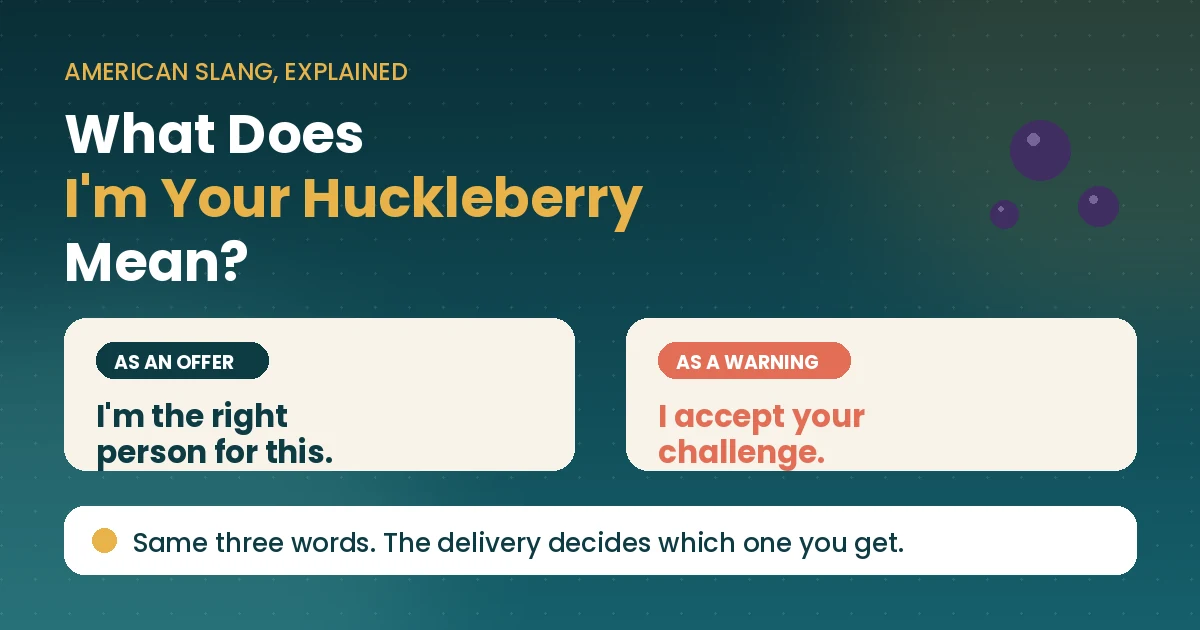
I’m your huckleberry means I am the right person for this job, or I accept your challenge. Say it, and you are putting yourself forward. You are telling the person that whatever he needs done or whatever fight he wants to get into, he has found his man.
It is known from Val Kilmer’s movie called “Tombstone,” which is dated to 1993, when Doc Holliday said it to Johnny Ringo with such an impudent smile that it could scare someone. The quote is 130 years older than the movie, and the story of it is better than the story that can be read on the Internet.
The Short Version:
| Question | Answer |
|---|---|
| What it means | I am the right person for the job, or I accept your challenge |
| Where people know it from | Tombstone, 1993, Val Kilmer as Doc Holliday |
| Is it really huckle bearer? | No. Kilmer confirmed it himself and titled his memoir I’m Your Huckleberry |
| How old is the phrase? | In print by 1862, decades before the film |
| Why a huckleberry? | The berry is tiny, so it first meant something small or trifling |
| The common misquote | I’ll be your huckleberry. The film line is I’m your huckleberry |
| Tone today | Playful, confident, slightly cocky. Not aggressive on its own |
| Did the real Doc Holliday say it? | No record of it. The line came from the screenwriter |
Where Most People Hear It First
So, What Does I’m Your Huckleberry Mean? The movie Tombstone reintroduced this term in American English. Val Kilmer is Doc Holliday, a consumptive dentist who became a gambler and gunslinger, and he says it twice to Johnny Ringo.
The first case occurs in a bar where Ringo is looking for a fight, but no one is going to get into a fight with him. Doc, already drunk and totally indifferent, volunteers for the job. The second case is when he is challenging Ringo to a duel in the trees, but instead of Wyatt Earp, Ringo finds Doc there. The same three words, but the meaning is absolutely different.
The repetition of the phrase explains its success. The first one was said as a joke, the second as a death threat. And you cannot understand what exactly Doc meant just by hearing the phrase.
The Huckle Bearer Myth, and Why It Is Wrong
Try searching this phrase, and you’ll end up with a certain statement where Doc Holliday says, “I’m your huckle bearer”, where the word huckle stands for coffin handle. According to that interpretation, he tells Ringo that he’s going to carry his coffin. Sounds cool, doesn’t it? It’s not correct.
- Val Kilmer clarified the issue once and for all. He commented on this phrase publicly back in 2014 and said it was “huckleberry”.
- His autobiography is titled “I’m Your Huckleberry”. It was published in 2020, four years prior to his death in 2025 at the age of 65. There’s no way an actor would choose a word from his script to title his own autobiography if he’d never said it.
- The script uses the word “huckleberry”. The phrase was common slang at the time, and it already stood for what the scene required it to stand for.
- Coffin handles were not referred to as “huckles”.
The reason why so many people get it wrong: Kilmer’s Doc says it with a Georgia accent, elongating the last syllable into a more huckleberr-uh type sound. Getting the misquote is understandable. Making a theory out of it is where it starts to fail.
That is why the myth lives on, because it makes for a much more interesting story than reality does, and the reality is that it takes a whole paragraph to describe.
The Real Origin: A Berry Too Small to Matter
- It’s a dark, small, wild berry, more similar to a blueberry than anything else. English people moving to North America spotted the berry and applied the closest name to the item, namely hurtleberry. The term became to sound like huckleberry and was even used in such form in the description of New York written in 1670.
- However, the point of interest is what followed. Due to the small size of the berries, Americans used the word in order to describe small things that have minor importance. Not as a praise. Just as a measurement of insignificance.
- Within a huckleberry of. James Kirke Paulding used the term in his book written in 1832 to say that somebody is as close as possible to smothered to death. Here we can assume that he meant a hair’s breadth.
- A huckleberry to a persimmon. This phrase was written in the very same book by the same author in 1832. A persimmon is the large fruit while huckleberry is small, thus, the phrase means an unequal bet.
- A huckleberry over my persimmon. Something that is just beyond one’s reach, but not much.
- No huckleberry himself. It was used in 1889 by Mark Twain to call somebody of no consequence.
Thus, the word originated as a means to refer to something small. This is completely different from how the word will appear in the town of Tombstone; therefore, the next point is worth considering.
How a Tiny Berry Came to Mean I Am Your Man
By the mid-19th century, huckleberry had a new life. The term began to refer to a sweetheart, friend, or reliable sidekick, someone who was fit for a job. This is language: a name for something small and sweet moves on towards affection, and affection moves on towards loyalty.
After this occurred, I’m your huckleberry became a phrase by which to declare oneself available. I am the one you need. I will do the job. Include me.
| Year | Source | How It Appears |
|---|---|---|
| 1832 | James Kirke Paulding, Westward Ho! | Within a huckleberry of being smothered to death |
| 1862 | Val C. Giles, Confederate recollections | All right, I’m your huckleberry, said over a dice game |
| 1879 | Henri Wilkins, The Coming Man | Now, I’m your huckleberry |
| 1883 | John Hay, The Bread-Winners | Used by a character agreeing to a task |
| 1900 | Edward Stratemeyer, True to Himself | Then I’m your huckleberry |
| 1993 | Tombstone | Doc Holliday revives it for a modern audience |
The above example is one to ponder. It pops up when one of the soldiers describes how two gamblers used loaded dice. The first man asks for the game while the other says, “I’m your huckleberry.” That same spirit exists in the movie. Thirty-one years earlier.

It Is Not I’ll Be Your Huckleberry
It’s the biggest mistake that people can make, and it’s important to get this correct, should you be quoting from the movie.
In Tombstone, the line is I’m your huckleberry. Not I’ll be your huckleberry, because that turns the line into something more like a promise for the future. This is a crucial difference because the point of the whole line is its immediacy. Doc is not promising to be your problem someday. He’s right there now.
Both versions were around in the period language, so neither version is incorrect in English. One is just the quote.
Did Doc Holliday Really Say It?
John Henry Holliday did not say it. It was written by screenwriter Kevin Jarre, giving the line to a character who was known for having a ready one-liner.
Why is it defensible? The line was part of the language of Southern and Western slang during Holliday’s lifetime, so it makes sense that a Georgia-born gambler might use such a line even if there is no evidence that he said it, making it more defensible than many lines of movie dialogue.
What about Johnny Ringo? He was found dead under a tree near Tombstone in July 1882 with a bullet in his head. No one was ever charged for his murder. The “duel” in the movie is fictional.

You’re No Daisy, and the Rest of the Slang
The period language in Tombstone is abundant but tends to get overlooked by modern audiences. Here are two such phrases that go hand-in-hand with the huckleberry phrase.
- “Daisy.” In the slang of 19th-century America, a daisy was something that was top-notch, superb – the cream of the crop. When Doc says to Ringo You’re a daisy if you do, he is challenging and praising him at the same time.
- You’re no daisy. Doc’s statement above the body of Ringo. Translation – You did not measure up to your own expectations. This insult is expressed in the form of a tombstone epitaph.
- Skin that smokewagon. A smokewagon was slang for a revolver. He is ordering him to draw.
Interpreting all three together changes the entire scene. No boasting – it’s a man speaking fluently in the language of his generation, and this is exactly why he is frightening.
How to Use It Today
The phrase has settled into everyday American English as a confident volunteer. It is playful more often than it is threatening, and tone does all the work.
- Volunteering for something. Somebody asks who can drive the van on Saturday. You say I’m your huckleberry. Light, a little showy, completely friendly.
- Claiming expertise. A friend needs somebody who understands tax forms. Same line, now meaning you have found the right person.
- Accepting a challenge. Said flatter and slower, it reads as go ahead and try me. This is the Tombstone register, and it is the one to use carefully.
- Quoting the film outright. Among people who know Tombstone, the line is a handshake. Half the room will answer with you’re no daisy.
One caution. Because it is strongly attached to one film and one accent, saying it with a drawl is read as doing an impression rather than talking. That is fine if it is the joke. It is less fine in a meeting.
Trivia
- Kilmer took the line for the title of his autobiography, which was released in 2020. Kilmer was the actor who portrayed Doc and made the actor’s disease known, and that performance is the most mentioned in Kilmer’s obituary after his death in 2025.
- The word came into English as hurtleberry and referred to the bilberry in Great Britain; it had become huckleberry by 1670.
- Twain called the child Huckleberry on purpose, because in an interview he gave in 1895, he noted that he wanted the boy to be of a lesser degree than Tom Sawyer, just like the smallness of the word suggested.
- The phrase cannot be traced to Twain’s authorship, however popular that misconception is; the phrase existed in the literature and in common usage apart from Twain’s works.
- Huckleberries do not grow well in farmed environments; they are hard to cultivate commercially, which is one of the reasons they remained a wild fruit.
- “Tombstone” was a controversial movie. It was written by Kevin Jarre, who was supposed to be the director but was dismissed early in production. However, it is only due to his lines that the movie is still quotable today.
- The death of Ringo is still unsolved, even though it was officially declared a suicide back then. However, Wyatt Earp is among those who have received credit for his death.
Frequently Asked Questions
It means “I am the right man for the job” or “I accept your challenge.” Depending on how it is said it can be either an offer of help or a threat.
“Huckleberry.” Val Kilmer stated it publicly and even titled his autobiography with that line. The huckle bearer explanation, referring to “a pallbearer carrying a coffin by the handle,” was made up by modern authors and lacks any period references.
Doc Holliday, portrayed by Val Kilmer, says that to Johnny Ringo. He repeats it twice: during a conversation in the saloon and at their final showdown.
The movie quote is “I’m your huckleberry.” The latter, “I’ll be your huckleberry,” is an erroneous quote. They both existed in 1800s literature, but not as a quote.
Nothing in writing indicates that he did. This quote is the creation of writer Kevin Jarre. It was common slang during the time of Holliday, so it sounds realistic, even though there is no documentation of it.
Because of its size. The word originally had the meaning of something insignificant, and later it developed to mean one’s sweetheart or a friend who can be relied upon.
Final Take
I’m your huckleberry means that I am who you are looking for. Originally, it was a term used to refer to something small; later on became something that refers to someone reliable and is now a quotation that is used for no less than three seconds in any Western.
The tale about the huckle carrier is the only one that should be corrected because the information is used everywhere and is not correct, while the true tale, about a small berry that eventually became a cowboy’s signature, is much more interesting.
Also Read: What Time Does Michaels Close | What Does Huzz Mean in Slang | What Does Goy Mean | What Episode Does Luffy Use Gear 5 | What Does Godspeed Mean