


The red color conveys meanings such as love, passion, anger, danger and power simultaneously. The red color is used to indicate hearts and roses, as well as danger signs, caution labels and even blood. No other color serves such opposing purposes as well as the red color.
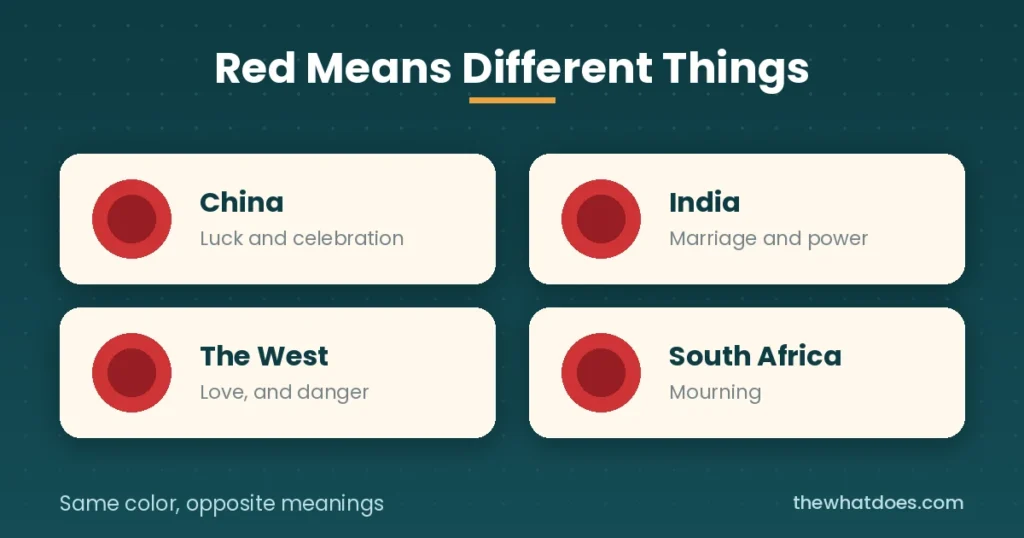
It all depends on the place you are in. Red in China means good fortune and happiness. In parts of Africa it represents mourning. In the Western world it is about love once a year and danger the rest of the days of the year.
The Short Version:
| Context | What red means |
|---|---|
| Emotion | Love, passion, anger, excitement |
| Safety | Stop, danger, warning, fire |
| China and much of Asia | Luck, prosperity, celebration |
| India | Marriage, purity, and the goddess Durga |
| Christianity | Sacrifice, martyrdom, the Holy Spirit |
| Politics | The left, almost everywhere except the United States |
| Business | Urgency, appetite, attention |
Why Red Hits Harder Than Other Colors:
Before getting into what does red symbolize culturally, it helps to know why this particular color does so much work.
Red occupies the longest wavelength spectrum perceivable by the human eye, and thus long wavelength scatters least when passing through the atmosphere. As a result, red remains perceptible from farther distances and under poorer weather conditions more than other colors, which partly explains why it was used for stop signs, brake lights and emergency vehicles long before the field of color psychology became a scientific pursuit.
There is another evolutionary advantage as well. Red is the color of blood and of an angry or aroused individual; both are stimuli which the human eye is programmed to notice before any cultural elements are added to it.
Finally, there is another observation made by linguists in the study of colors in various languages. Researchers observed that among the languages having just three color names, black, white and red, in that particular order, are invariably present as the first three colors.
The Two Faces of Red:
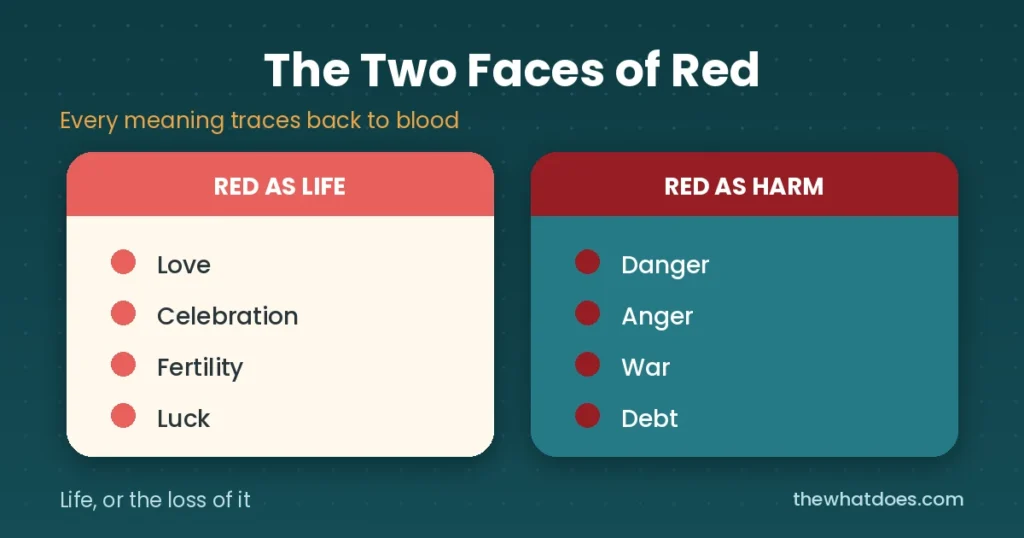
Almost all connotations that red evokes relate directly to one of two concepts: red as a symbol of life, or red as a symbol of injury.
Red as life: love, passion, fertility, celebration, good health, vigor. The flushed cheek of the one laughing, the dress of the bride, the red envelope containing money for New Year’s Day.
Red as injury: danger, aggression, war, warning, debt, sin. The flushed cheek of anger, the red light, the red mark on the paper, the flag of the blood-red beach.
The same color, referencing the same substance, read two different ways. And that is the essence of red symbolism in one thought, explaining why the meanings change so readily depending on context.
Red Around the World:
| Place | What red means there | Where you see it |
|---|---|---|
| China | Luck, joy, prosperity | Weddings, New Year, red envelopes |
| India | Marriage, fertility, power | Bridal saris, sindoor, festival colors |
| Japan | Life, protection, the sun | Shrine gates, the national flag |
| Western Europe and US | Love, but also danger | Valentines, and warning signs |
| South Africa | Mourning and sacrifice | In the national flag’s meaning |
| Russia | Beauty and revolution | An old word meaning both red and beautiful |
| Ancient Rome | War and power | Military cloaks and banners |
Here is an interesting example of how language can impart meanings to colors. In Russian, the word for “red” and the word for “beautiful” are related linguistically, which is why “Red Square” in Moscow got its name before red had any political connotations at all.
Red in Religion:
Every great tradition employs red, but almost no one uses it for the same purpose.
Red in Christianity is used to denote the blood of Christ and the Holy Spirit during Pentecost. The priests in the Christian religion wear red on certain days because of these reasons.
In Hinduism, red is seen to be extremely auspicious. It is the color of marriage, the color of the goddess Durga, and the color of sindoor that the married women wear.
Buddhism associates red with the energy of life and conservation and is also found in the robes of the Buddhist monks.
In Ancient Egypt, there were two sides of red; it represented life and victory and also the desert, chaos, and the god Seth. Egyptians used to write the name of dangerous objects using red ink.
Red in Politics, and One Big Exception:
Red color is predominantly associated with the left-wing politics all around the world, since its origins go back to the French revolution of the 18th century when it became a symbol of the socialists and the labor movement.
But in America, the opposite colors belong to the opposite parties: red is the color of Republicans and blue – of Democrats.
This allocation of colors is younger than the majority of the citizens can even imagine; in fact, up until the year 2000, American channels had been using inconsistent coloring of their maps, sometimes even switching them from one election to another.
The current color choice was cemented by the results of the presidential elections of 2000, which took several weeks to determine. This way, any interpretation of the colors should depend on the country in question.
Red in Business and Design:
Red is used by designers if they need to draw attention to their products and make people react immediately.
- Sales and discounts. Price tags in red catch customers’ attention and are processed faster than any other colors.
- Food and restaurants. Red color is often used by fast food brands – partly because of its ability to be seen, and partly because it is appetizing.
- Warnings and errors. Red color indicates that something is wrong or should be stopped everywhere.
- Luxury details. Red object against the background of white or black will look confident, but not loud.
- Buttons and calls to action. Red attracts people’s attention, although it becomes less effective in all-red environment.
And the only warning about using red is that it is very loud, and when something is used loudly everywhere, it stops being heard.
Does Red Actually Affect Performance?:
This is actual research, and it is more intriguing than the assured-sounding citation that you will commonly encounter.
Researchers from Durham University investigated four combat sports in the 2004 Olympics, in which players wear either red or blue by random assignment. Those wearing red won around 55% of contests, and more than 60% of contests where the two athletes were evenly matched. In an article published in Nature, they proposed that red could be associated with dominance, as it is in several animals.
But then there was the problem. Another group showed similar winning patterns in Olympic competitions where the athletes wore no red at all. In addition, it did not replicate when other researchers investigated the 2008 Olympics.
The honest take is that while the red advantage is a genuine finding, it has not been replicating since.
Red in Everyday Language:
The meaning of idioms remains unchanged, and English has many red ones.
| Phrase | Meaning | Which face of red |
|---|---|---|
| In the red | Losing money | Harm |
| Red flag | A warning sign | Harm |
| Seeing red | Furious | Harm |
| Red-handed | Caught in the act | Harm |
| Red carpet | Honor and welcome | Life |
| Red letter day | A day worth celebrating | Life |
| Painting the town red | Celebrating loudly | Life |
“Red-letter day” is derived from ancient calendar systems wherein feast days were marked in red while the rest of the days were marked in black.
Common Mistakes People Make About Red:
- Assuming it to mean the same everywhere. Luck in one country, mourning in another, danger in a third.
- Considering the findings from the sports study as definitive. The initial finding couldn’t be replicated and has been questioned.
- Interpreting US political colors as universal. Everywhere else, red means the left.
- Using too much of it in design. Red relies on contrast. A wall-to-wall red design no longer stands out.
- Omitting the cultural/religious context of the color. For a Hindu wedding, red is the most auspicious color. For a Western funeral, it would not make sense.
- Assuming red always signifies aggression. It can also stand for welcome, celebration and luck.
Red Trivia:
- In those languages that use only three terms for color names, these names are usually black, white and red.
- Red colors are some of the first colors to be used by human beings, as seen in cave paintings done in red ochre.
- The Red Square in Moscow received its name because of its beauty rather than political motives or because of the color of the bricks.
- In old calendars, religious festivals were marked in red ink, from which comes the expression red letter day.
- Red light is scattered less by air, hence travels farther even in fog than any other color.
- The 2005 Olympic experiments found that those athletes wearing red color won about 55 percent of the contests.
Final Take:
The answer to what red stands for is simply that red stands for intensity in general, and the culture surrounding it chooses what type of intensity. Either love or anger, good fortune or risk, joyousness or warning, but every single meaning stems from the color of blood, either living or dead.
This is why red is never a neutral decision. Use it in a dress, warning sign, wedding invitation or political map and it will make a statement. It all depends on who the audience is.
Frequently Asked Questions:
Love, passion, anger or excitement. In all cases, the color evokes an intense feeling.
This is due to both our natural reaction to blood, as well as the way light physics works. Red light is able to travel longer distances than any other color in air and fog, which made it the obvious choice for signals before symbolism was considered.
Red stands for good fortune, happiness and prosperity. Red dominates wedding festivities, and is worn during the Chinese New Year. Money is placed inside of red envelopes as gifts.
The color is highly symbolic of good luck, weddings, fertility and the goddess Durga. Traditionally, brides wear red, while married women wear sindoor.
Blood, sacrifice, and martyrdom, and in the Church, additionally, the Holy Spirit. Red clothing is worn on special occasions specifically for this purpose.
Red stands out immediately and suggests an urgency. This is due to the difference between red and the surroundings and not the magic power of the color.
An experiment conducted in 2005 on Olympic combat sports showed that athletes in red won more often, yet follow-up research showed the same results in cases where red had no effect, and did not work again in the next Olympics. Take it as not proven.
Due to its connection with the flushed face, the heartbeat and rose, and due to the long tradition of Western culture in this respect.