

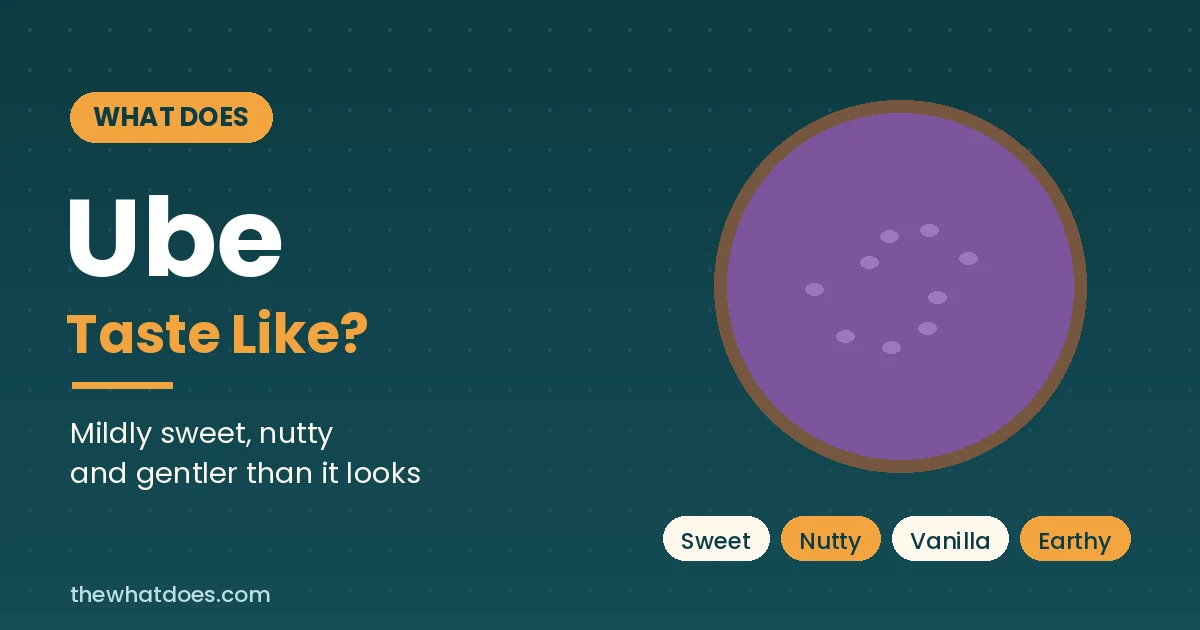
Ube has a mild sweetness and a nutty flavor to go along with it, with a hint of vanilla throughout it and a creamy texture.
It can also be described as a mixture of white chocolate, pistachio, and coconut with a slight earthiness because it is actually a root vegetable.
It is also far more delicate than one would assume just from its appearance. When someone has eaten purple ube ice cream, which was bright and very sweet, they were probably eating extract and coloring.
The Short Version:
| Question | Answer |
|---|---|
| What it is | Purple yam that is commonly cultivated in the Philippines |
| Main flavor | Mildly sweet and nutty with hints of vanilla |
| Closest comparisons | White chocolate, pistachio, coconut |
| Texture | Tender, soft and creamy |
| How sweet | Not as sweet as one would expect and never naturally sweet |
| Real color | Lavender to violet, not fluorescent |
| Pronounced | OO-beh |
Breaking Down the Flavor:
So what does ube taste like if you eat it plain, steamed, with nothing added? Four things, roughly in this order.
- Mild sweetness. Authentic and true, but subtle. Not as sweet as a sweet potato, and definitely not a dessert before adding any sugar.
- Nuttiness. Next in prominence to its mild sweetness. The best description comes when people compare it to pistachios.
- Vanilla. This is what gives ube its dessert-quality characteristics instead of those of a vegetable. Potatoes and yams do not typically have this characteristically pleasant aroma.
- A delicate earthiness. There’s a hint of something you should remember is pulled out of the ground. In a good ube dessert this translates into depth rather than a reminder of its origin.
And the texture speaks volumes as well. ube, when cooked, is moist yet slightly dense. When mashed, it becomes very creamy.
What Ube Tastes Like Compared To:
| If you know | Ube is | The difference |
|---|---|---|
| White chocolate | In similar territory | Far less sweet, and not at all buttery |
| Pistachio | Close on the nutty note | Softer, with no salt and no crunch |
| Coconut | Sharing that creamy sweetness | Earthier, without the tropical tang |
| Sweet potato | A rough starting point | Less sweet, more aromatic, more vanilla |
| Taro | Related in role, not in flavor | Ube is sweeter and more perfumed |
| Vanilla ice cream | Similar in how it reads as dessert | Rounder and nuttier, and not as sweet |
Summary for a novice: Think of vanilla ice cream with sweetness toned down and something nutty kicked up.
What Is Ube, Exactly?:
Ube is a variety of purple yam, called Dioscorea alata by botanists and recognized by most of the world through Filipino cuisine. The skin is dark and barklike, and its interior can be anything from light lilac to very dark violet.
This is a real yam, and it’s worth stating that what is referred to as a “yam” in American markets is usually a sweet potato.
In the Philippines, it is an ingredient used primarily in desserts. The mainstay of it all is ube halaya – a thickened mixture made with milk and sugar – which features in just about everything else that is made with ube: ice cream, cakes, the shaved ice dessert halo-halo, and the purple pandesal rolls.
Why Your Ube Might Not Taste Like the Ice Cream:
This is the reason why most articles fail to mention, and it accounts for most of the confusion on this page.
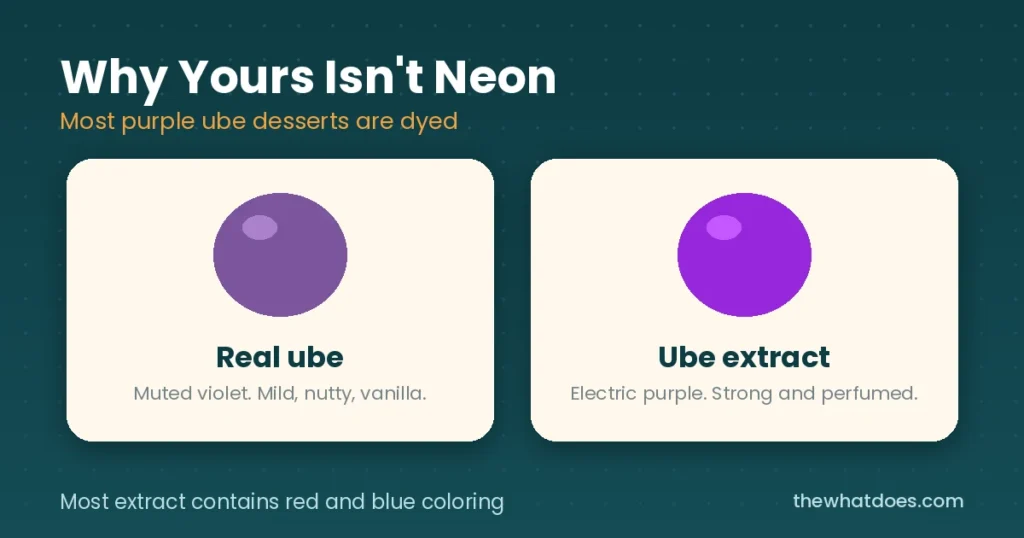
Ube yams are difficult to obtain anywhere else apart from Asia. As a result, much of the ube-flavored items found in the Western world are made using ube extract instead of the actual yam. Most brands of ube extracts use red and blue food coloring, which is why the extracted product has such an almost artificial bright purple color.
Actual ube does not have such a bright color. It takes a more understated approach, ranging from dusty lavender to muted violet once cooked and mashed. Anything with a bright, almost glowing color has been dyed.
The taste is the same way. The ube extract has a strong, sweet, and perfumed taste, while the actual yam has a milder one. Neither one is necessarily wrong, although they don’t taste the same and many people who claim to be fans of ube have only eaten the extract.
To try out actual ube, you need to seek out frozen grated ube, halaya ube, or pure ube powder with one item listed on its label.
The Forms You’ll Actually Find It In:
Ube is available in five states outside of the Philippines, and they do not all taste alike.
| Form | What it is | What to expect |
|---|---|---|
| Fresh ube | The whole yam | Rarity in markets outside Asia, requires peeling and steaming |
| Frozen grated | Peeled and grated, then frozen | Most efficient way to achieve true ube flavor |
| Ube halaya | Sweetened cooked jam | Ready-to-eat, delicious, and used as the foundation for most desserts |
| Ube powder | Dried and milled yam | Good taste and good color as long as one ingredient is stated on the label |
| Ube extract | Concentrated flavoring | Powerful taste, and often artificial coloring for the purple |
In whatever case that ube is the main subject, the first four are always better than the fifth one. Extract deserves its recognition as a complement to real ube.
Ube vs Taro vs Purple Sweet Potato:
These three confuse people all the time because of the way cafes list purple as one flavor.

| Ube | Taro | Purple sweet potato | |
|---|---|---|---|
| What it is | A true yam | A different root entirely | A sweet potato |
| Flesh color | Lilac to deep violet | White with purple flecks | Deep purple, leaning blue |
| Taste | Sweet, nutty, vanilla | Mild, starchy, potato-like | Sweeter, caramel-like |
| Texture cooked | Moist and creamy | Starchy, slightly sticky | Drier and fluffier |
| Used for | Mostly desserts | Sweet and savory dishes | Both, often roasted |
One detail worth knowing: taro isn’t purple. The lilac taro bubble tea you’ve seen gets its color from powder mixes and coloring, not from the root. Taro flesh is white with faint purple speckles.
So on a cafe menu, purple usually means dye. In a Filipino bakery, purple usually means ube.
What Ube Desserts Actually Taste Like:
| Dish | What it is | How it tastes |
|---|---|---|
| Ube halaya | A thick sweetened jam | Creamy, rich, and nutty |
| Ube ice cream | The most common introduction | Vanilla-like, nutty, and sweet |
| Ube pandesal | Soft purple bread rolls | Slightly sweet and usually stuffed with halaya or cheese |
| Ube crinkle cookies | Cracked, sugar-dusted cookies | Moist, cake-like, and lightly fragrant |
| Halo-halo | Shaved ice with many toppings | Ube is the creamy one among the others |
| Ube latte | Milk drink with ube powder | Ube is the creamy one among the others |
How Ube Ended Up Everywhere:
Ube has been an essential ingredient in Filipino desserts for decades now. What’s different today is whom else it has caught the attention of.
For Filipino-Americans, the 2010s were all about using this ingredient in various Western desserts: banana bread, cinnamon rolls, cheesecake, and donuts. The purple hue was enough to do the trick. By 2020, it had its Instagram moment, and the dessert has become common in Western cuisines.
It’s worth stating clearly, since most articles get this wrong: there is nothing novel about ube. It has been part of one type of cuisine well before it became fashionable in another cuisine. The only novel thing is its marketing strategy.
Does Ube Go With Savory Food?:
This happens very rarely, and that is what distinguishes it from taro.
The uses of taro are plenty in stews, soups and frying dishes in many cuisines. Ube, on the other hand, is solely used for desserts in Filipino cuisine and its flavor of vanilla makes it look really out of place beside garlic and fish sauces.
Its use crosses into bread and dairy products. Coconut, condensed milk, cheese and butter are all compatible with it. Its use with cheese looks weird to people unfamiliar with this, but it is one of the better things in a Filipino bakery.
Common Mistakes People Make With Ube:
- From the extract. Majority of desserts with a bright purple ube are flavored and colored. The yam is not as strong in taste.
- Expecting the dessert to be neon purple at home. The real deal comes out dull. Nothing is wrong.
- Confusion with taro. It is a different plant with a different taste. Also taro does not naturally occur purple.
- Using purple sweet potato instead. This helps in getting that color, although you miss out on the taste of vanilla and creaminess.
- Expecting ube desserts to be very sweet. Naturally it is not so sweet. The sugar is added in ube desserts.
- Purchasing the extract when you really meant the real one. You should look for frozen grated ube, halaya or ube powder.
Ube Trivia:
- The word “ube” sounds like “OO-beh” (from Tagalog), and not “cube.”
- This is an actual yam, not one of those sold as yams in the American supermarkets.
- Fresh ube is very hard to find in the western world, and this is why many ube foods there begin their way from the extract.
- Red and blue dyes are usually used in ube extracts, and these two are responsible for the purple color of desserts.
- Another popular purple-flavored drink, taro, is actually white with violet speckles.
- Ube halaya, or sweetened ube jam, is the main ingredient of all other ube dishes.
Final Take:
The straightforward answer to “What does ube taste like?” is more tame than what the name suggests: subtly sweet, with notes of nuttiness, vanilla, and creaminess that are grounded by an earthy base. It reads like something you would find in a dessert without being overtly sweet, making it one-of-a-kind among root vegetables.
For those who know only of purple ube ice cream served at an ice cream shop, it’s worth seeking out the real deal just once.
Frequently Asked Questions:
No. These are distinct root vegetables that have distinct tastes. For example, unlike taro, ube has a more nutty, vanilla-like taste and is generally more sweet and creamy.
It is mildly sweet but not as sweet as sweet potatoes. It does not have any taste of sugar on its own. Any sweetness in ube desserts is contributed by sugar and condensed milk.
Yes. It is actually the unique taste of vanilla in ube that makes it work well for desserts.
Ube has naturally occurring pigments that make it take on shades of lilac and dark violet. However, the bright purple color of shop-bought ube desserts is contributed to artificial food coloring in ube extract.
In terms of color, yes, but not so much in taste. Purple sweet potatoes are sweeter and have more of a caramel-like taste with a dryer texture and no vanilla notes.
It tastes like a nuttier ice cream that is less sweet than vanilla ice cream and creamy in texture. Those prepared using extract have a more perfumed flavor than those prepared from the actual tubers.
Also Read: What Time Does Walmart Close on Christmas Eve | What Does a Semicolon Tattoo Mean | What Does Zeebo Do at the Church in To Kill a Mockingbird | What Does Matcha Taste Like | What Time Does Chick-fil-A Stop Serving Breakfast

