

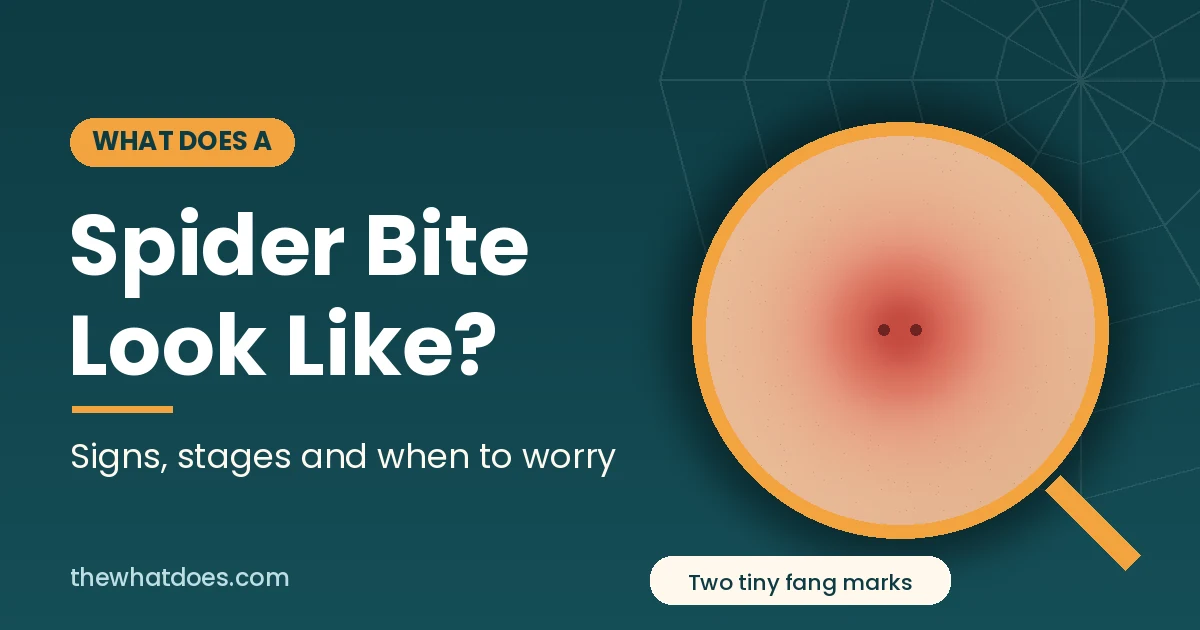
A common spider bite is a small red lump, which is slightly raised and sometimes irritated or itchy, much like a mosquito bite or a bee sting. In most cases, bites remain the same for several days before disappearing in roughly a week’s time. However, there are some spiders that are capable of delivering more serious bites, which will show some signs to identify their presence.
The difficult thing about recognizing spider bites is the fact that there are many conditions that have identical symptoms. Mosquito and bug bites, ingrown hairs, and skin infections all begin from a raised, red lump, and people who think they were bitten by a spider have not seen one. Here, you will learn about the symptoms that accompany each bite and the signs that require medical attention.
The Short Version:
| Type of Bite | How It Looks | How It Feels | How Serious |
|---|---|---|---|
| Common spiders (house, wolf, jumping, sac) | Small reddish bump with swelling, often with a small blister | Short stinging sensation followed by itching or soreness | Generally mild, lasts for a week |
| Black widow | Faint red spot, occasionally with two very small spots or a pale area surrounded by a red circle | Piercing sensation followed by pain and cramping sensations | Can be very severe, seek medical help |
| Brown recluse | Reddish patch that might have a blister, along with a pale circle and a dark blue/purple spot | Usually starts without pain, but pain develops within hours | Generally mild, though some develop ulcers |
| Skin infection mistaken for a bite | Swollen red bump that increases in size, hot, and becomes filled with pus | Intense throbbing pain that worsens | Requires doctor, usually takes antibiotics |
What Does a Spider Bite Look Like at First?:
So, what does a spider bite look like in the first few minutes and hours? Well, it depends on the individual, but in general, it is barely noticeable at all. One may see a small, red or pink spot, slightly swollen and about the size of a pea. The area can be somewhat warm and even itchy and painful to touch.
There could be a small blister right in the center of it, or the bite could leave hardly any marks at all until the person starts feeling itchy. Spiders bite their victims once, so there would be only one bite instead of many. This fact makes it easier to distinguish between various bites.
Most spiders cannot really do any damage to people anyway. In the whole world, there are only a few species that have fangs capable of piercing the human skin and venom potent enough to affect the victim.
Do Spider Bites Leave Two Fang Marks?:
Rarely, but not as rarely as people think. The spiders use their fangs to make a bite, so technically, you could see two little dots side by side. But since most everyday spiders have very small fangs, the dots usually blend right into the swellings.
Two puncture wounds can be seen with the bite of a black widow, and it is one piece of evidence used to diagnose them. But the lack of fang marks does not mean it isn’t a spider bite, nor does two little dots mean that it is a spider bite. Two insect bites next to each other may appear very similar.
What a Harmless Spider Bite Looks Like:
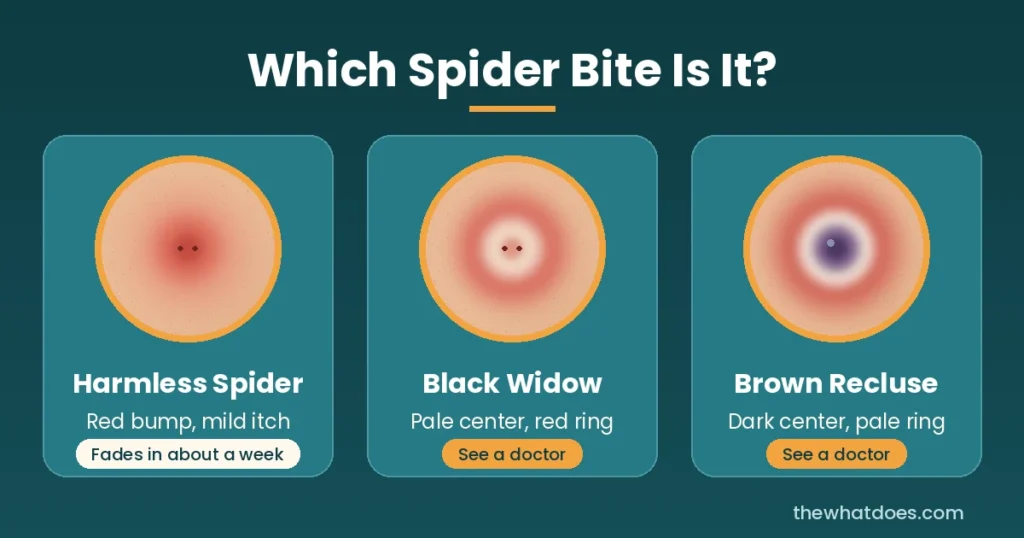
Some of the spiders that humans come across frequently in their homes are the wolf spiders, jumping spiders, yellow sac spiders and common house spiders. If any one of these spiders bites, it is likely to look something like this:
- One raised red or pink spot, sometimes surrounded by a slightly elevated area
- Swelling that occurs only in the area of the bite
- An itching, stinging or dull pain sensation that disappears after two days
- Sometimes a little blister in the center
Spiders which are larger in size like the wolf spiders are capable of giving a painful bite that feels a little like that of the bee sting, but still the mark remains small in size. The pet tarantulas also have the ability to bite. While the bite of a tarantula causes much pain and not danger, their hair tends to irritate the skin even more than their bite does.
These bites heal automatically in one week time.
What Does a Black Widow Bite Look Like?:
It may actually be quite difficult to see a bite of the black widow. Usually, the area of bite looks like small red spot with two little dots. After 20 minutes or within an hour after the bite, it may start showing a pale area surrounded by red ring.
The characteristic feature of the bite is the pain rather than its appearance. The bite usually starts with a sting, and then becomes dull and widespread. Later on, pain may move from the bite site to the abdomen, lower back or chest with involvement of muscles spasms. Abdominal pain may become very intensive so much that it may be considered to be appendicitis.
Also, there may be other symptoms such as:
- Intensive sweating either locally or generalized
- Nausea, vomiting or headache
- Trembling, irritability or increased heart rate
- Spasms of abdominal, shoulder or back muscles
The symptoms may persist for up to three days. The healthy adults will recover from the condition completely, while young kids, older patients and those with heart problems are at greater risk. If you suspect that a bite is from the black widow spider, do not delay getting help until later.
The female black widow spider is black and glossy and has an hourglass-shaped mark underneath its abdomen. Only the females are regarded as dangerous to humans.
What Does a Brown Recluse Bite Look Like?:
Brown recluse spider bites are not always felt initially. There are patients who do not experience anything at all apart from a mild sensation of pain or burning, with the appearance of the skin being typical redness. Pain usually develops gradually over several hours.
From here, the bite either becomes dormant or begins to evolve. Majority of the brown recluse bites remain harmless and heal well. In those cases where complications arise, the skin will take on the distinctive pattern:
- The blister at the center of the bite
- The area in the center becoming bluish, purplish or grey because the tissue is dying
- The whitish ring surrounding the center
- The red outer border of the bite
Sometimes, it is called the red, white and blue sign. As days pass, the center sinks a bit and dries out. In the severe cases, it becomes black scab that peels off to reveal an open sore that will require weeks or months to fully heal.
Other symptoms are fever, shivers, body pains, or even skin rash. In rare cases, there will be systemic reaction from the bite and this is common with kids. It’s important to note dark red urine after being bitten by recluse spider.
The brown recluse spider has tan to brown coloration with darker violin marking on its back and six eyes as opposed to eight eyes.
Brown Recluse Bite Stages
It is not always the case with each mouthful. Some will cease after the first or second stage.
| Time After the Bite | What You May See | What You May Feel |
|---|---|---|
| First few hours | Tiny reddish mark, or no mark at all | No pain at first, then dull burning sensation or ache |
| Days 1 to 2 | Mark gets bigger, blister forms, mark appears pale or blue | Tingling, itchy feeling, possibly even fever or shivers |
| Days 3 to 7 | In bites that progress further, mark with dark center, surrounded by pale area and red margin | Pain around the margins |
| Weeks 1 to 3 | Crusty black crust on top of injured skin, and there may be an ulcer underneath | Pain reducing gradually in most cases |
| Up to 3 months | Crust falls off, and ulcer heals slowly, and a scar may develop | Wound heals, often with minimal pain |
Spider Bite vs Other Bug Bites:
Since there are many identical bites, sometimes the shape and the placement are more revealing than the bite itself. This is how a spider bite differs from the common offenders.
| Bite | What It Looks Like | Where and How Many | Useful Clue |
|---|---|---|---|
| Spider | Single red bump, which can sometimes develop into a blister or two small spots | Usually single bite, usually at location where spider was caught in between the skin | The itch or pain takes time to develop |
| Mosquito | Puffy swelling, usually appearing quickly | Usually single bite, usually at location where spider was caught in between the skin | Extremely itchy, disappears within a few days |
| Bed bug | Itchy, red, small bumps | Lines or clustered in arms, neck, face, or shoulders | They appear after sleep |
| Flea | Red spots that may have a reddish halo surrounding them | Clustered on ankles and lower leg area | Found in households that have pets |
| Tick | Small red spot, with the tick still attached | Usually single bite, usually on head, armpit, waist or groin area | Found in households that have pets |
| Chigger | Clusters of extremely itchy red welts | Around the waistline, sock line or behind knees | Usually reaches its peak 1 or 2 days after exposure |
| Bee or wasp | Clusters of extremely itchy red welts | Usually single sting | Usually reaches its peak 1 or 2 days after exposure |
Bites upon waking up usually aren’t from spiders because spiders do not feed on blood and therefore have no reason to keep biting you.
Is It Really a Spider Bite?:
And here is something that will shock many people: majority of the “spider bite wounds” are actually caused by something else. In one emergency room study of 182 patients claiming spider bite, only 7 patients had a spider bite diagnosis. 86 percent of them had a skin infection instead.
The most frequent source of infection is the staph infection, including the methicillin-resistant staph, which does not react to the usual antibiotics. These infections usually start as a red and sore bump, which resembles a bite, and then develop into swollen and warm wound filled with pus. Waiting the bite to heal itself, considering that it is a harmless spider bite, might lead to the spread of the infection.
Other conditions that can easily be mistaken for a spider bite are the following: boils, hair folliculitis, shingles, allergic reaction, poison ivy and insect bites. Some characteristics of the brown recluse bite, which is the main fear, do not support the bite:
- Multiple sores at once or new sores appearing in the same household
- Early appearance of pus or cloudy discharge, suggesting infection more strongly
- A raised, puffy lesion like a boil as opposed to a flat one
- A sore that develops within a day or two rather than a week or longer
- Residing in an area where brown recluses do not live
If you didn’t witness a spider biting you, be flexible and consult your doctor about it if the sore is growing in size or pain.
How Long Does a Spider Bite Take to Heal?:
Spiders bites generally heal in a period of seven days. The redness and swelling reach the highest peak in the first one or two days, and they gradually decrease. In case you develop an itch where the bite occurred, the mark could persist for a little while more, especially in cases where it gets scratched.
The damage done on the skin by black widow spider bites is minimal, while the systemic symptoms will usually subside in one or three days. On the other hand, brown recluse spider bites take the longest time in developing into ulcers, which require between days and weeks to heal if they are mild and three months in case of deep ulcers.
A bite that keeps getting worse after two or three days, or it has not started healing after a week, requires medical evaluation.
What to Do Right After a Spider Bite:
Home treatment should be sufficient in cases where you receive a light spider bite from a spider that you are reasonably confident is non-poisonous:
- Clean the bitten area with mild soap and warm water to reduce the risk of infection.
- Apply a cold, wet compress or an ice-pack covered in cloth to the bite location for 15 minutes every hour to reduce swelling and pain.
- Keep the area elevated if the bite is located on the limbs.
- Use over-the-counter pain killers to alleviate any pain.
- For itching, use an oral anti-histamine, Calamine lotion or over-the-counter hydrocortisone cream.
- Draw a line on the outside of the redness and monitor how the redness develops beyond the line.
- Where possible, capture the spider in a container or take a clear photograph of it. This will be of much more value to a physician than a description.
Things to avoid include:
- Do not cut open the wound or attempt to suction out the venom.
- Do not put heat on the wound.
- Do not burst any blisters that form or pick at any scabs.
Do not tie the area tightly. In case you decide to seek medical attention, your tetanus shot will be checked as well.
When to See a Doctor for a Spider Bite:
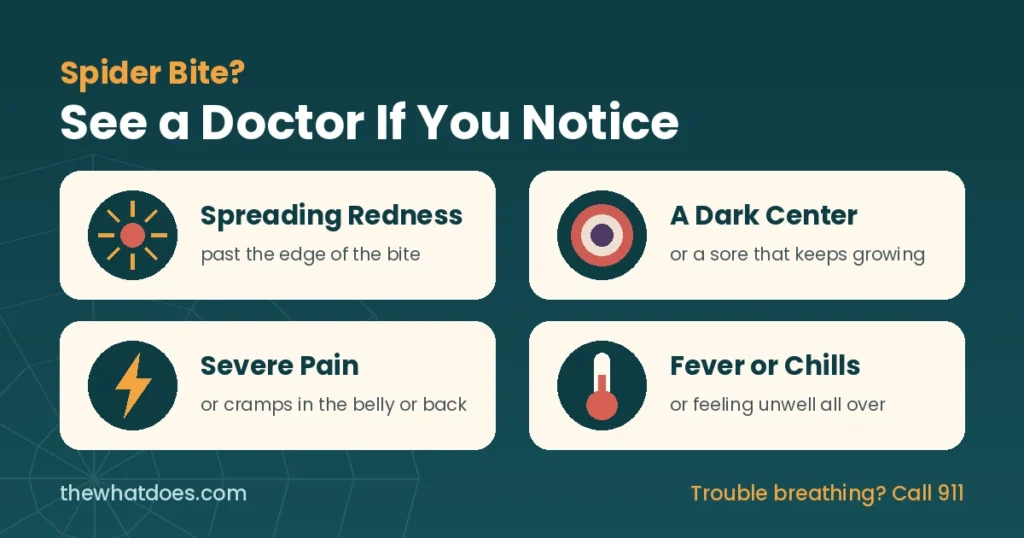
Seek immediate medical help if:
- You suspect the bite comes from a black widow or brown recluse spider, or you cannot identify the spider
- There is extreme pain, or your abdomen is cramped up and you are experiencing muscle twitching
- The wound gets bigger or the spot becomes darker
- There is spreading redness, streaks of red leading away from the bite, the spot is warm and filled with pus
- There is a fever, chills, or pains throughout the body
- A child or an elderly individual was bitten by a potentially venomous spider
Go to the ER immediately if you experience:
- Difficulty breathing or swallowing
- Swelling of the face, mouth, tongue, and throat
- A fast heart rate, fainting or disorientation
- Dark or reddish colored urine after a bite
The Poison Help number 1-800-222-1222, which operates 24/7 in the US, is a free-of-charge hotline. The experts on duty will advise you if you need to seek treatment at a hospital.
Which Spiders in the US Can Actually Hurt You?:
In the USA, there are only two types of spiders that are considered medically important: widow spiders and recluse spiders.
These include black widows and brown widows. Black widows are found throughout the country, but predominantly in the Southern states. These spiders can be found in dark, sheltered environments including wood piles, sheds, garages, meter boxes and underside of outdoor furniture.
Brown recluses are predominantly found in the southern-central and Midwest states, and some other similar recluse species are found in the desert Southwest. These spiders reside in areas of reduced activity such as boxes, closets, attics, unused shoes and bedding. Bites are often caused by contact of spider against the skin, e.g. pulling a boot or glove that the spider is in.
Hobo spider was once considered responsible for flesh wounds in the Pacific Northwest. However, it was removed from CDC’s list of venomous spiders due to lack of evidence.
Globally, the spiders of greatest reputation include Australian funnel web spiders, Brazilian wandering spiders and the Australian redback which belongs to the same family as the black widow.
Common Mistakes People Make With Spider Bites:
- Blaming all the reddish sores on a spider. Skin infections occur much more frequently and require a different treatment approach.
- Waiting for too long. Bite that is spreading, leaking pus or becoming more painful in one or two days must be taken to a doctor, not waited.
- Popping the blister. It will invite bacteria in to the irritated skin.
- Throwing the spider away. If it is safe, it should be kept in a closed container. Knowing the species could be useful for doctors to prescribe proper treatment.
- Believing it is a brown recluse bite if you are not living in recluse country. In places where these spiders are not found, chances of being bitten by one are very low.
- Using dangerous home remedies. Cutting, suction, applying heat and putting bandage are useless and harmful.
Spider Bite Trivia:
- Approximately 50,000 different species of spiders have been identified worldwide, but not even 50 could pose any real danger to humans.
- There was a case when researchers found 2,055 brown recluse spiders in a house in Kansas within six months, and none of the four occupants of the house got bitten by them.
- Members of one spider family known as hackled orb weavers do not have venom glands; they use an incredible amount of silk for capturing and storing prey.
- Only females of the black widow spider can be seen as dangerous to humans since males are relatively tiny and harmless.
- Brown recluses have six eyes arranged in pairs, unlike other spiders who have eight.
- Another misconception about spiders is related to the idea that people accidentally swallow several spiders annually while sleeping. Spiders try to stay away from warm, breathing and moving object like human body.
Final Take:
Usually, however, the answer to the question of what a spider bite looks like is much easier – an itchy, stinging spot which goes away within a few days. The symptoms of spider bites which require concern appear differently – either through pain and cramping, spreading from the bite in the case of black widow bites, or blisters with dark centers for brown recluse bites.
If, however, a wound keeps getting bigger and warmer and develops pus, its most probable cause isn’t a spider bite but a bacterial infection.
This article is for general information only and isn’t a substitute for advice from a doctor.
Frequently Asked Questions:
Not really. Since all spiders’ bite marks tend to be quite similar, it is hard to distinguish them from bug bite marks or from skin infections. Doctors use your symptoms, progression of the bite, your geographical location, and the spider itself.
No. Spiders have two fangs, but not all of them leave any marks visible to the naked eye and those that do might be covered by swelling. If there are two tiny dots, they may mean a bite of a black widow.
Most of the spider bites heal within one week. The symptoms of a black widow’s bite subside in one to three days, while that of a brown recluse, which develops an open wound, takes up to three months.
It becomes increasingly inflamed. You need to watch for redness which spreads rather than recedes, inflammation, warmth, swelling, formation of pus or a yellowish crust, red streaks coming out of the point of infection, and fever or chills.
No. Avoid bursting the blister since doing so will make it more susceptible to infection since this will open up the skin barrier.
No. There may be a bulls eye sign on a black widow bite, and also if the bulls eye rash develops a few days after a tick bite then it might be a sign of the Lyme disease. The skin infections and some allergic reactions might produce a ringed appearance so any bulls eye sign that is enlarging should be brought to the attention of the doctor.
The bites appear to be similar to those on adults; however, children may be hypersensitive to the bite of a black widow and brown recluse spiders.
Also Read: What Time Does Walmart Close on Christmas Eve | What Does a Semicolon Tattoo Mean | What Does Zeebo Do at the Church in To Kill a Mockingbird | What Does Matcha Taste Like | What Does Ube Taste Like | What Time Does Chick-fil-A Stop Serving Breakfast | What Does Berberine Do | What Does the Name Ava Mean
