Most of the world’s largest religions give the same answer: God has no physical appearance whatsoever – no face, no body, nothing a camera could photograph. The religion of Judaism, Islam and Sikhism make this explicit. Most Christian theology concurs. Hinduism believes that God is formless and simultaneously takes on countless forms by which He can be reached.
Where did the old man with the white beard come from? Well, he’s mostly a product of art. This convention of Western painting for the last thousand years is not the way that any scripture has ever described God.
This article outlines the beliefs of different traditions. It does not advocate for any of them, nor does it belong to any particular one.
The Short Version:
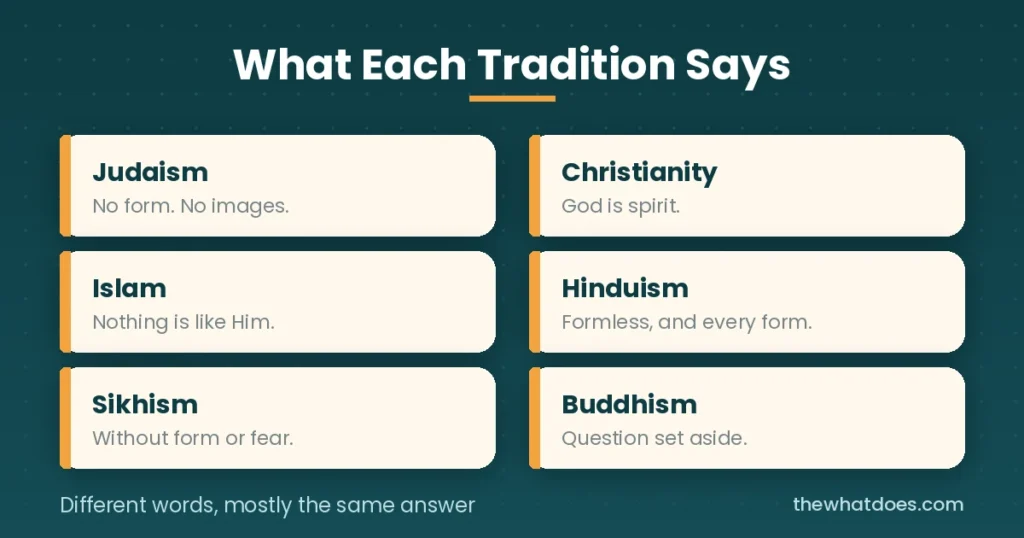
| Tradition | Does God have a form? | In short |
|---|---|---|
| Judaism | No | God does not have a body; making images is forbidden |
| Christianity | God is spirit | Christians view God in terms of Jesus and not a face |
| Islam | No | Nothing at all is like Him; images of any kind are out |
| Hinduism | Both | Formless in nature but approachable in many ways |
| Sikhism | No | God is formless, and images are never made |
| Buddhism | Not applicable | Not many schools revolve around the concept of a creating God |
| Non-religious views | No | God is viewed as an idea and not as a being |
Why the Question Is Harder Than It Sounds:
Asking what does God look like assumes something most theologians would question first: that God is the kind of thing that has a look.
Seeing requires light to reflect off a surface. A surface implies a body, which implies a form and a location; however, none of these apply in traditional descriptions of God. In such a system, the inquiry into what God looks like can be likened to wondering about the scent of Tuesday. It’s a logical construction, but not a meaningful one.
This is why scriptural descriptions of God tend toward metaphorical language; descriptions of blinding light, fire, thunder, a voice, and a presence all come across as descriptions of an experience rather than a likeness.
Where the Old Man With the Beard Came From:
In fact, for roughly a thousand years, representations of the Father, specifically in Christianity, were completely avoided by artists. The traditional way out of this was the depiction of a hand emerging from the clouds, a representation used even in a third-century synagogue at Dura Europos.
It was based on Biblical passages that claimed that no one had ever seen God, and that no one could look at his face and survive. However, throughout the Middle Ages in Western Europe, the approach became less strict. First, it was just a head of God, then a full-figure representation, and finally, at the beginning of the Renaissance, there were representations of God in full.
The iconic fresco painting of God created by Michelangelo in 1512 in the Sistine Chapel has cemented the image: God the Father is now usually portrayed as a white-bearded powerful old man, stretching toward Adam. This is what most people imagining God actually picture nowadays – a painted image.
It was copied from the Book of Daniel, where God is described as Ancient of Days, having hair like wool and garments as white as snow.
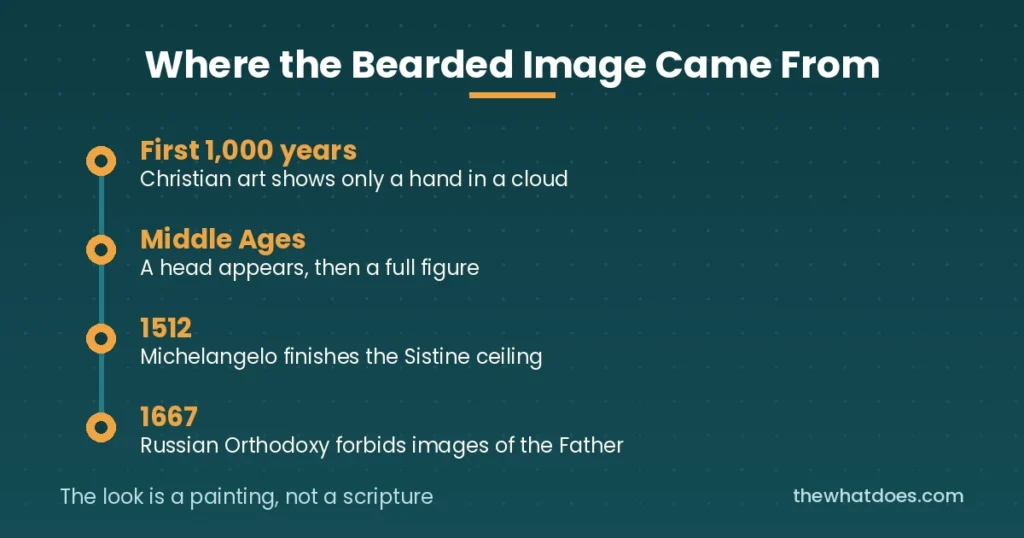
Everyone did not comply with this. In 1667, the Russian Orthodox Church decided to ban the representations of God the Father in a church council because no one has ever seen Him. There were serious complaints by early Protestants as well. It was an invention of the Western Catholics that came into practice.
What the Bible Says About God’s Appearance:
Less than one would think, and the very little that exists includes hedging right from the start.
- In Exodus, God tells Moses that he cannot see his face and live, so Moses gets to see only God’s back.
- Ezekiel starts with a description of something on a throne that has “the likeness of the appearance of a man,” and is “likened unto the appearance of fire” surrounded by brilliant rainbows. It’s more of a list of descriptions like “likeness,” “appearance” instead of simply stating what it was.
- In Daniel, it is “The Ancient of Days, Whose hair was like the pure wool; and His throne was fiery flames.”
- According to John, no one has ever seen God, and he goes on to say that God is spirit.
Taken as a whole, these scriptures say two things at once: people have witnessed something awesome, but no one has seen God in the flesh. Christianity is mostly in agreement that God is revealed through Jesus himself.
However, there is another branch of Christianity that differs on this point. The Church of Jesus Christ of Latter Day Saints believes that God the Father has a physical body of flesh and bones.
Judaism: No Body, No Image:
This is true of the Jewish belief system, too, for the simple reason that God is not physical and no image can be made of him according to the Second Commandment among the Ten Commandments.
The medieval thinker Maimonides included this as an absolute principle of Judaism when he said that God is not bodily and that nothing corporeal can be ascribed to God, and where the Bible refers to God’s hand or face, it should simply be taken as a metaphorical expression so that man can at least get some idea of a God whom it is not possible to describe.
As a consequence of this, there is no depiction of God in Jewish art, only depictions of presence – light, cloud, fire, the place above the ark.
Islam: Nothing Is Like Him:
The Islamic teachings are the most direct on this issue. According to the Koran, nothing in this world resembles God, and even comparison is impossible.
According to Islam, God is one and without partners, not born and not giving birth, and he cannot be conceived by man. The images of God are not created, and it is not about tastes or traditions; it is an integral part of beliefs. This is why the Islamic art was so advanced in the way it was developed, taking the direction of geometrical and pattern art, where words of God could convey more than images of him.
When speaking of phrases such as the face or hand of God used in the Koran, the major schools of Islamic theology do not accept a physical interpretation of it. Muslims may have different opinions concerning the vision of God in the afterlife; according to the Sunnis, people will see Him.
Hinduism: Formless and Every Form:
The Hindu tradition is the one which offers the most complex answer, but this is also the one which is often misinterpreted from the outside.
The ultimate reality in Hinduism, called Brahman, is defined in its purest form as formless and attribute-less. No picture is able to represent it, no name can do justice to it.
However, the tradition in Hinduism is full of form. God is worshipped in various deities, with their faces, names, myths, and pictures, as well as statues.
The most common interpretation of this paradox is that the infinite reality may assume any form accessible to a believer, and this form is only a gateway, not a limitation.
Therefore, the answer to this question is not that Hinduism worships many gods while other traditions worship none.
Sikhism, Buddhism and Others:
According to Sikhism, God is one and formless, fearless and hateless, timeless and eternal. This is how Sikh scriptures begin. Sikhs do not create any image of God, and their places of worship have the scripture but not the statues.
The issue is largely avoided by Buddhism. In most sects, there is no teaching of a Creator God, and Buddha did not wish to speculate about such matters. The statues of the Buddha are only images of a teacher, not of a god, no matter how they look to an outsider.
For non-religious perspectives, the answer to this question is very simple: there is no appearance of God because there is no God at all.
What Made in God’s Image Means:
The description of humans as being made in the image of God in the Book of Genesis is frequently understood as meaning that God resembles humans. This view, however, goes against the views held by most theologians of both Judaism and Christianity.
Interpretations have always pointed at a quality other than physical resemblance such as moral accountability, intelligence, creativity, relationality, or stewardship of the earth. Given that the belief of these religions in the absence of a body of God, physical likeness would be in total contradiction of other teachings.
The practical importance of the term has mostly been in emphasizing human dignity in that each person bears God’s image rather than the actual physical form.
How People Actually Picture God:
Irrespective of theology, human brains form an image and researchers are aware of the images formed.
Researchers at the University of North Carolina at Chapel Hill conducted a study with 511 Americans who were Christians in 2018. The participants were shown many pairs of randomly altered faces and asked to choose the face which appeared to them similar to their image of God. The composite face formed by these selections had a certain appearance.
This image appeared to be youthful and less austere compared to the Michelangelo version. However, it was the underlying pattern that was noteworthy. Youthful individuals had a more youthful image of God. Individuals who considered themselves attractive had a more attractive image of God. African Americans imagined a more African American looking God compared to whites.
The scientists termed this process of imagining God as egocentrism, where we have the tendency to project our own self onto others. The findings were that humans tend to imagine a God who thinks like us as well as appears to us. There was one aspect which remained constant; both men and women imagined a male God.
How to Answer a Child Who Asks:
It is this question that is asked by children more often than by any other person, normally before sleep and often without preparation of any response on your part.
There are some answers that always work well regardless of what your personal beliefs are:
- Answer honestly. No one knows, and no adult does either. Children will understand better than you expect.
- Answer with the invisible things analogy. Love, music, and the wind are real yet faceless. It is a concept that children understand easily enough already.
- Ask them first. How would you imagine God? You might learn something very interesting and learn why the question was asked in the first place.
- Separate the image from the concept. If they have seen the bearded image before, it is acceptable to say that this is how one artist imagined God many years ago.
- Leave the question open. It is not required to answer every question asked within one evening.
Sometimes the real question behind this one is actually not about appearances but whether God sees, cares, or is close.
Common Misconceptions:
- The Bible depicts God as an old bearded man. This depiction is based on the imagery of Ancient of Days and Renaissance painting.
- All Christians accept images of God. Orthodoxy and some Protestant traditions have historically rejected images, sometimes in written doctrines.
- That created in the image of God means God looks like us. All mainstream interpretations of “image” refer to reasoning, morality, and relationship rather than appearance.
- Hinduism worships God in forms only. Hindu philosophy also talks about the nature of the absolute reality as being formless.
- Buddha statues are images of gods. They are images of teachers and most Buddhist traditions have no concept of a Creator God.
- God has gender. The vast majority of world religions see God as beyond gender regardless of pronoun use in texts and languages.
Trivia Worth Knowing:
- Christian art for about a millennium represented God solely in the form of a hand coming out of a cloud.
- A representation of a hand is used in a third-century synagogue in Dura-Europos which predated any Christian artwork.
- The Russian Orthodox church officially banned representations of God the Father in 1667.
- The elderly man in Renaissance paintings was inspired by a vision recorded in the Book of Daniel.
- Islamic calligraphy developed into one of the leading forms of art because representing God was never considered.
- In a study done in 2018, the mental image of God that people created looked like the people themselves.
Final Take:
The most accurate answer to what does God look like is that nearly every major tradition says the question doesn’t apply. God is defined as formless, beyond images, and beyond the scope of eyes designed by our bodies to perceive. The descriptions that we have of God in scriptures are accounts of an awesome experience of God, but not descriptions in any artistic sense.
The bearded old man is a painting. A great painting, which has influenced how billions of people envision their God, but still an imaginative work created by a human painter, not a description of any vision actually witnessed. And the question that remains unanswered by most religions remains unanswered.
Frequently Asked Questions:
No, not literally. There are statements that no one has ever seen God, and He is spirit. The visions found in Ezekiel and Daniel contain descriptions of light, fire, and the throne using specific wording such as likeness and appearance.
This kind of iconography originates from Western art of the Renaissance period and takes allusions from the Ancient of Days described in the Book of Daniel. This image was set by Michelangelo on his ceiling of the Sistine Chapel; it has no scriptural basis.
Traditionally, it is believed that God has no sex at all. Masculine terms used in scriptures correspond to the linguistic context and society of their authors and thus can be regarded as purely grammatical in most theological opinions.
The Islamic view on God is that nothing is similar to Him, and that He is unimaginable and undepictible. That’s why depictions of God do not exist; it is one of the reasons why Islamic art is so highly developed in calligraphy and geometry.
It is both formless and infinitely manifold. God is defined as having no shape, but worship of him is in terms of many shapes with associated stories and pictures.
The answer from most Jewish and Christian perspectives is no, since God’s bodylessness is an aspect of the tradition, even though the concept refers to reason, morality, creativity or relation rather than physical appearance.
This is one of those questions for which the scriptures themselves contain a definite answer. It is clearly stated in the Bible that no one has ever seen God. The traditions vary on whether it is possible to see God even after death.
Honesty and then discussion of his ideas. No one knows is a legitimate response. Comparisons of God to things that have no form in real life, such as love or wind, give the child an understandable concept. The real question is about goodness and proximity, not appearance.
Also Read: What Time Does Walmart Close on Christmas Eve | What Does a Semicolon Tattoo Mean | What Does Zeebo Do at the Church in To Kill a Mockingbird | What Does Matcha Taste Like | What Does Ube Taste Like | What Time Does Chick-fil-A Stop Serving Breakfast | What Does a Spider Bite Look Like | What Does the Name Ava Mean | What Time Does Target Close | What Time Does UPS Stop Delivering