


Patchouli smells earthy, woody and faintly sweet, like damp soil after rain with something darker underneath. The best quality patchouli has a strong, almost chocolate-like depth. The bad patchouli smells harsh, green, and medicinal, giving the oil a bad name.
These are actually one and the same ingredient at various stages of its life. Patchouli is one of the few essential oils that age well, and there is a huge difference between fresh and five-year-old oils.
This means that most people who claim to hate patchouli have probably experienced the wrong kind of it.
The Short Version:
| Question | Answer |
|---|---|
| Main impression | Earthy and woody, with a sweet undertone |
| Closest comparisons | Wet soil, old wood, dark chocolate |
| The harsh version | Sharp, green, medicinal. Fresh oil is used more often |
| The good version | Smooth, wine-like, warm. Usually aged |
| Where it comes from | Leaves from a plant in the mint family |
| In perfume | Base note. One of the most long-lasting notes |
| How long it lasts | On skin for hours, on clothes for days |
Breaking Down the Smell:
Asking what does patchouli smell like gets a different answer depending on which facet someone noticed first. There are five, and most patchouli has all of them in varying proportions.
Earthy. The main character of patchouli and the one which people will either adore or despise. Not like earth, but like rain forest soil or freshly tilled garden.
Woody. Dry, dark, somewhat dusty. More like old piece of furniture than an actual tree.
Sweet. The character that exists in good patchouli and doesn’t exist in bad. It comes late and smells of balsam rather than sugar.
Camphor. Meditative, medicinal sharpness that is reminiscent of the back of a herbalist’s shop. Very strong in the fresh oil and almost non-existent in aged one.
Musty. Like old books, a basement, a vintage store. This is the character which people mention when they say that they don’t like it.
In aged patchouli there is one other character that gets added to this ensemble – dark fruits and chocolate.
What It Smells Like Compared To:
| If you know | Patchouli is | The difference |
|---|---|---|
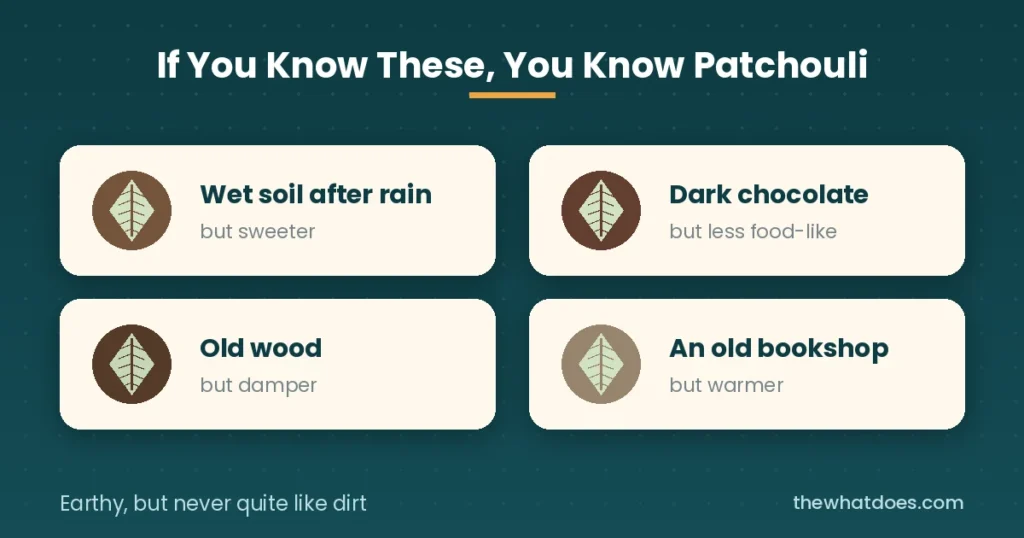
| Wet soil after rain | In the same family | Sweeter, and far more persistent |
| Dark chocolate | Related in the aged version | Less food-like, more resinous |
| Cedar or sandalwood | Sharing the woody base | Damper and more earthy |
| An old bookshop | Close on the musty note | Warmer, with sweetness underneath |
| Vetiver | The nearest relative in perfumery | Vetiver is drier and smokier |
| Incense | Often in the same blend | Patchouli is heavier and less airy |
The honest truth about it if you’ve never smelled it before: think of the smell of damp soil, decaying wood, and some dark chocolate together, and that will last much longer than you thought possible.
Fresh Oil and Aged Oil Are Different Things:
This is the most valuable information regarding patchouli and the explanation behind virtually all debates about the plant.
Almost all oils are prone to deterioration after being stored. This does not apply to patchouli, which, when left in darkness for many years, loses its rough camphor-like qualities and gains a rich flavor instead.

| Age | How it smells | Where you’d meet it |
|---|---|---|
| Freshly distilled | Green, sharp, camphorous, raw | Cheap oils, incense, craft supplies |
| One to two years | Settling, less bite, more body | Mid-range blends |
| Three to five years | Smooth, wine-like, chocolatey | Fine perfumery |
| Longer still | Deep, rounded, expensive | Sought after and priced accordingly |
Aging material is deliberately sought out by perfume manufacturers and even fetches higher prices because of that. If the only patchouli you’ve smelled was in a bottle from a market stall, then you know what the raw material smells like before it has been softened.
The Living Plant Doesn’t Smell Like This:
Patchouli is derived from an evergreen herb of the mint family, native to Indonesia, India, and other parts of Southeast Asia. Just pluck any leaf from the plant and squish it a bit, and what you’ll get will be green and have a somewhat herbal odor. But not the same odor you’re used to.
The distinctive odor is only formed when the leaves have been dried and partially fermented, and their physical structure broken down in order to allow the heavier aromatic compounds to form. Only then can they be steam-distilled.
Therefore, patchouli is an “aroma” rather than a “natural” odor in the same sense as coffee, chocolate, and tea are.
Where the Hippie Reputation Came From:
That patchouli was associated with the 1960s is true, but the explanation most often provided for this association is not.
It was said that the scent of patchouli was used to cover up the smell of marijuana and unwashed bodies. This story is always repeated but has very little substance to back it up. What is recorded about patchouli dates further back and is more fascinating.
In the nineteenth century, Kashmiri shawls were transported in dried leaves of patchouli to keep off moths during the long journey across the sea. These shawls smelled of patchouli, and the smell became the way to determine whether it was a true Indian import. European manufacturers who wanted to create fake shawls would use patchouli oil to scent their products to fool people.
So, patchouli came to the Western world as a sign of luxury from abroad, a hundred years before it represented the counter-culture.
You’ve Smelled It Without Knowing:
It is the element which will shock those who are absolutely certain they despise it.
Patchouli is probably the most commonly employed base note in all of the perfume industry and lies hidden below thousands of perfumes on sale today. Patchouli adds depth, anchors other notes together and, when used in small doses, adds warmth to a perfume rather than patchouli.
It is the foundation of the chypre accords and the ingredient which made the basis of modern sweet fragrances due to one famous fragrance launched in 1992 based on the accord of patchouli and chocolate-like notes. The majority of the perfumes described as deep, dark and addictive contain patchouli in their compositions.
Despising patchouli as a soliflore and appreciating it as three percent of the fragrance composition is perfectly normal position to take and most people have both without even knowing it.
What It Blends With:
- Rose. The classic combination. The soil underneath the flower makes it non-sweet and non-cultivated.
- Vanilla. Provides that warm and sticky element in many contemporary gourmands.
- Citrus and bergamot. Makes the head brighter so the base does not overshadow it.
- Sandalwood and vetiver. Enhances the wood note. The very dry accord.
- Oud. Combination of two powerful notes. Nothing sophisticated here.
- Chocolate and coffee. Goes one step further in terms of patchouli.
How to Try It Properly:
- Try an older oil or a perfume that uses patchouli, rather than the cheapest product on the shelf.
- Dilute the fragrance. Undiluted patchouli can be too much and creates an illusion of how it truly smells.
- Test on skin rather than on paper. Patchouli smells very different once it warms up.
- Give it thirty minutes. The initial sharp opening scent is not what it smells like; it’s just the first thirty seconds.
- Use less of the fragrance than you would use of another scent because it lasts for a very long time.
Common Misconceptions:
- Its similarity to earthiness rather than dirt.
- All patchouli smells the same. It can be significantly altered by age and place of origin.
- It is a seventies scent. It actually entered Europe in the nineteenth century via trade in textiles.
- The hippie cover-up story is true. It is always said, and there is no proof to the contrary.
- You can smell the plant. Its fresh leaves are green and herbal, not at all like the oil.
- You don’t like it. You’ve most likely worn it and not realized it.
Trivia Worth Knowing:
- Patchouli oil comes from the mint family, although it seems quite unbelievable due to its odor.
- Patchouli is the only essential oil whose quality enhances with time instead of deteriorating.
- It was the nineteenth-century buyers who distinguished the authentic Indian shawls from the European imitations through its odor.
- This unique odor is created only when its leaves are dried and fermented.
- It is one of the most extensively used base notes in the natural perfume industry.
- Its longevity on fabrics for many days has led to its utilization against moths.
Final Take:
The full answer to what does patchouli smell like is earthy, woody and sweet, with a camphor sharpness when it’s young and a chocolate-and-wine depth when it’s old.Soil that is damp, timber that is dark, and warmth below the surface.
If you believe you dislike it because of the way it smells, chances are you tried it while it was still very young, inexpensive, and applied in great excess. An old oil in tiny amounts left to sit for half an hour will provide a new experience.
Frequently Asked Questions:
One of the scents that split the opinion on a nose-to-nose basis. Mature patchouli is warm, sweet, and rich, which is very much appreciated by perfumers. The fresh and cheap oil is sharp and medical, and this variant is responsible for most of the hate.
It is earthy, which is somewhat true, but there is a sweet and woody note of something other than dirt. Damp floor of a forest might be a more fitting comparison.
It became popular in the hippie culture of the 1960s, and the legend about its use to mask other smells is repeated all the time without evidence. The actual way it came to the West is through textiles in the 19th century.
Neither of them. This ingredient is present in all types of perfumes, from dark and woody compositions to sweet gourmands.
For a very long time. It stays on the skin for hours and fabrics for days. It is one of the slowest components to evaporate from the fragrances which is precisely what makes it a great fixative.
One of the scents that split the opinion on a nose-to-nose basis. Mature patchouli is warm, sweet, and rich, which is very much appreciated by perfumers. The fresh and cheap oil is sharp and medical, and this variant is responsible for most of the hate.
Because harsh and camphor-like notes become soft with time and give way to deep and sweet ones. Most oils degrade when stored. This one is an exception. That’s why aged batches of patchouli are more expensive.
Rose, vanilla, sandalwood, vetiver, citrus and oud. Patchouli is a great base for almost anything because it brings a depth to it and helps to prolong other notes.
Indeed. More than in most other natural base notes. Most people who consider themselves patchouli-haters use it in their fragrances anyway and just don’t know it.
Also Read: What Does KYS Mean | What Time Does Chick-fil-A Stop Serving Breakfast | What Time Does Walmart Close on Christmas Eve