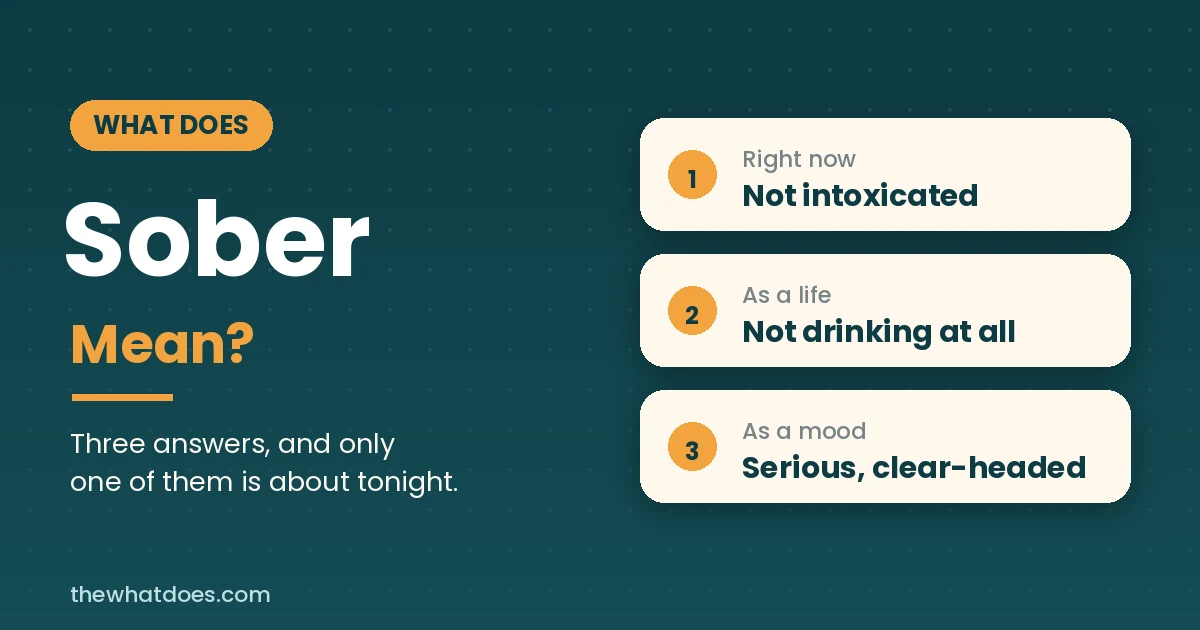
There are three different definitions of sober, each of which can be used depending on the sentence. They are: not drunk at the moment, which means that this person does not consume alcohol right now; permanently abstaining from alcohol or drugs; serious, composed, with no relation to intoxication.
The phrase “Are you sober enough to drive?” refers to the first definition. “She has been sober for two years” refers to the second one. “A sober evaluation of the risks” is an example of the third usage.
Most of the websites provide information on the first meaning. The second is actually what people usually refer to, while the third is where the word comes from.
The Short Version:
| Meaning | What it means |
|---|---|
| Not intoxicated | No alcohol or drugs affecting you right now |
| In recovery | Choosing not to drink or use, ongoing |
| Serious or restrained | Clear-headed, plain, not showy |
| Sobriety | The state or practice of staying sober |
| Sober up | The process of becoming unimpaired again |
| The one thing that works | Time. Nothing else speeds it up |
Meaning One: Not Intoxicated Right Now:
The most basic way to feel it. You either have nothing at all, or what you do have is gone.
This is the version in play when somebody asks what does sober mean in the context of driving, working or signing something. It’s a temporary state rather than a description of a person.
It is important to understand that the feeling of being sober does not equate to the state of being sober. Alcohol impacts judgment before impacting physical coordination, which is the very reason that those who are intoxicated think that they are not.
You Cannot Speed It Up:
It should be included in any factual writing about the word as there are many misconceptions around it and some are even potentially harmful.
The rate at which the body processes alcohol is constant – 1 unit per hour – and nothing will alter it. No amount of coffee will speed up the process. No cold shower will help either. Nor will food, fresh air, physical activity, energy drinks, or illness.
What those factors will achieve is altering a person’s level of alertness, which is detrimental. A person drinking excessive amounts of alcohol and then consuming three cups of coffee is still intoxicated but more confident to go ahead and do whatever it is he wants.
Meaning Two: Sober as a Way of Living:
If someone tells you they’re sober, this is what they mean. Sobriety involves not drinking and not doing drugs, not for a night but as a continual decision.
Different people come to it via completely different paths. For some, it means having had a real struggle with substance abuse. For others, it has nothing to do with problems but is a conscious decision to be happier without it. Some gave up due to health, medical issues, pregnancy, religion, or dislike.
It’s important to recognize how varied these pathways can be since the notion of sobriety as a recovery process from addiction is incorrect for a number of people and uncomfortable for most.
The Vocabulary Around It:
| Term | What it means | Note |
|---|---|---|
| Sober | Not drinking or using | The broad term |
| Sobriety | The state of being sober | Often counted in days or years |
| In recovery | Actively working on addiction | Implies a history. Sober does not |
| Sober curious | Questioning drinking without quitting | A growing movement |
| Dry January | A month off, as a reset | Temporary by design |
| California sober | Avoiding some substances but not all | Contested, and means different things |
| Teetotal | Never drinks, by principle | Older British term |
The misconception that most people misunderstand is that of sober individuals vs. those in recovery. All individuals in recovery are sober; however, there are many sober individuals who were never in recovery.

Meaning Three: The Original One:
Prior to anything to do with alcohol, sober had the connotation of serious, temperate, and rational. This connotation exists in common English usage even today.
- A sober evaluation. Realistic and unromantic.
- Sober colors. Subdued and modest, not colorful.
- A sober disposition. Calm and serious, typically after unpleasant events.
- Sobering. Anything that stops you in your tracks and causes you to be serious.
The word has its roots in Latin, composed of a prefix for lack of and the word drunk. Not being drunk is the primary meaning of the word. The serious and temperate definition came secondary to the primary definition, since those are traits associated with individuals who are not drunk.
What makes sobering noteworthy is the fact that sobering statistics literally carry out the job of the word.
What to Say to Someone Who’s Sober:
This happens all the time, and much of the difficulty could be avoided.
- Don’t try to get an answer. The excuses run the gamut from physical ailment to troubled past, but none of them are ever owed to you.
- Don’t pressure them. “One drink won’t hurt me” is the sentence everyone wants to hear that scares the sober person most, and sometimes it isn’t true.
- Don’t make it a discussion item. Mentioning it at the table makes a personal decision into a discussion among the group.
- Do offer them an actual drink. One that isn’t watered-down lemonade in a Styrofoam cup.
- Do act normally. They just want the night to go on without them feeling obligated to explain themselves about their lack of a drink.
- They can bring it up themselves if they wish. This is the entire trick.
The short answer: it’s just like anything else they don’t have.
If You’re Thinking About Stopping:
There is one caution here, and this is why this whole section is not just an inspirational call to arms.

Stopping abruptly after heavy drinking and doing so often will have consequences for your body that can be truly harmful. Alcohol withdrawal is one of those things that can seriously injure you. That doesn’t mean that you should not stop. This means that you need to discuss the situation with your physician first in order to ensure that the process will be painless and safe.
However, for anyone else, moderating their drinking or quitting completely is a totally normal action to take, and there are many who do it without professional help at all.
In the US, SAMHSA National Helpline provides free, confidential and round-the-clock counseling on issues of alcohol or drug abuse at 1-800-662-HELP (4357).
Common Mistakes People Make With the Word:
- Assuming sober is synonymous with recovering. Lots of sober people have never been addicted.
- Assuming that coffee improves things. It makes a person both wide-awake and impaired rather than sober.
- Using good to mean sober. The former comes before the latter.
- Confusing sober and in recovery. The latter means something that the former doesn’t.
- Ignoring that sober has many meanings. It has nothing to do with drinking when soberly evaluated.
- Wondering why a person isn’t drinking. Normal and caring, and what sober people complain about the most.
Trivia Worth Knowing:
- It derives from Latin and translates to “not drunk.”
- The serious and conservative meaning evolved from the former rather than the latter.
- “Such a sobering statistic” is the same metaphor in action.
- Alcohol is processed by the body at a constant rate that cannot be accelerated by anything we know of.
- Dry January originated as a public health movement and turned into a worldwide practice.
- “Being sober curious” refers to a desire to question alcohol consumption without abstaining from it, which resulted in a boom in sales of non-alcoholic beverages.
Final Take:
The complete answer to what does sober mean is three answers. Not drunk right now. Not drinking as a way of life. And clear-headed, sober and understated in a way that doesn’t have anything to do with substance use at all.
When someone says they’re sober, they usually mean the second and the only response is a regular one. In case you are trying to figure out when you’ll be sober again, then the only answer is time and lots of it.
Frequently Asked Questions:
In most cases, it refers to not drinking and taking drugs as a personal choice. But it does not necessarily mean that the individual is in the process of overcoming addiction. The latter should be avoided.
The average rate of processing the alcohol consumed is one drink per hour, and nothing can speed it up. The caffeine in coffee, cold showers, and food affect alertness but not impairment itself.
Sober refers to abstinence from alcohol and drugs. Being in recovery implies efforts to deal with addiction. All those who are in recovery are sober. However, not all who are sober have had an addiction problem.
Doubt regarding your attitude towards alcohol without going as far as becoming abstinent from it. Sober curios may reduce their alcohol consumption, go through dry periods or quit completely after reflection.
Not consuming certain substances but others, particularly alcohol and stronger substances while sticking with marijuana.
No. The traditional definition involves being serious, reserved or lucid, as in a sober analysis or sober colors. This definition is still used.
Yes, it tends to be an inappropriate inquiry. The motives are highly individualized and asking this question subjects a person to the embarrassment of having to explain their reasoning in public. They will do so if they wish to.
Not necessarily. It may be harmful for those who have been drinking heavily and frequently to just stop; therefore, consultation of a physician may be wise.
Also Read: What Does Patchouli Smell Like | What Does KYS Mean | What Time Does Chick-fil-A Stop Serving Breakfast | What Time Does Walmart Close on Christmas Eve